The Rosebank oilfield rebellion is threatening to create a major political test for Prime Minister Andy Burnham, with 75 Labour MPs reportedly joining forces to oppose government approval for drilling at Britain’s largest remaining untapped oilfield. The growing opposition could also trigger resignations within his government if a licence is granted.
According to a report by The Sunday Times, the Labour MPs have privately signed a letter urging the government to reject the proposed development, arguing that opening the Rosebank field would undermine Britain’s international reputation on climate action without delivering meaningful reductions in household energy bills.
The reported scale of the opposition presents a significant challenge for Burnham as he attempts to balance the government’s energy security ambitions with Labour’s climate commitments. The dispute has become more urgent following the recent approval of another North Sea development, the Jackdaw gas field, near Aberdeen.
Although no final decision has been announced on Rosebank, pressure is mounting from both supporters and opponents of further North Sea drilling. The outcome could expose divisions within Labour over the country’s future energy strategy.
Seventy-five Labour MPs reportedly oppose Rosebank
The campaign against the oilfield is said to involve 75 Labour parliamentarians who believe approving the project would send the wrong message about Britain’s commitment to tackling climate change.
The MPs reportedly argue that additional oil production would not necessarily translate into lower energy bills for consumers. They are also concerned that proceeding with the project could weaken the UK’s credibility when urging other countries to reduce fossil fuel dependence.
The letter has not yet been made public, but its reported strategy is modelled on the campaign by Labour MPs who successfully pressured the previous government under Sir Keir Starmer to abandon proposed cuts to disability benefits.
That earlier rebellion demonstrated how organised parliamentary opposition could force a government to reconsider a controversial policy, particularly when a substantial number of its own lawmakers were prepared to challenge the leadership.
The latest campaign could create a similar predicament for Burnham, especially if the MPs maintain a united position when the government eventually considers the Rosebank licence.
One parliamentary private secretary (PPS) is also reportedly considering resigning if the government approves the development, raising the possibility that the disagreement could extend beyond parliamentary criticism to departures from official positions.
The PPS told The Sunday Times that supporters of the project might be underestimating how strongly some Labour politicians feel about climate change.
The individual argued that, for an entire generation of politicians, protecting the environment has become as central to political beliefs as promoting equality and tackling poverty.
Jackdaw approval intensifies pressure on the government
The controversy has intensified following Energy Secretary Miatta Fahnbulleh’s recent approval of plans for drilling at the Jackdaw gas field near Aberdeen.
The decision has encouraged supporters of North Sea exploration to demand that the government also approve Rosebank, which is located approximately 80 miles north-west of the Shetland Islands.
Rosebank is regarded as Britain’s largest remaining untapped oilfield, making it an important focus of the debate over domestic energy production and the future of the North Sea industry.
Neil McCulloch, chief executive of Adura, the company behind the Jackdaw project, has argued that approval of Rosebank should follow the decision on the gas field.
For supporters of further development, the argument centres on energy security, domestic production and the economic value of exploiting resources in British waters.
They contend that continued access to North Sea oil and gas could help strengthen the country’s energy supply, particularly at a time when international conflicts and instability have contributed to volatility in global fuel markets.
However, environmental campaigners reject the argument that approving additional fields is consistent with the UK’s climate obligations. They insist that new developments risk extending dependence on fossil fuels at a time when governments should be accelerating the transition to cleaner energy.
Burnham’s climate commitments face a political test
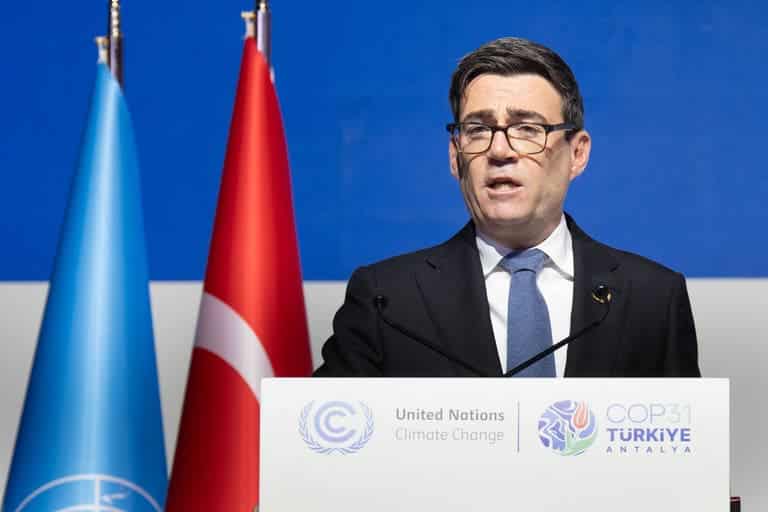
The dispute comes shortly after Burnham addressed the COP31 United Nations climate change conference in Turkey, where he reaffirmed Britain’s commitment to tackling global warming and achieving its 2050 net-zero target.
During his speech, the prime minister warned that the climate crisis was already affecting communities and economies across the world.
He described the recent summer, marked by extreme heat, wildfires and drought, as abnormal and said the consequences of climate change were no longer a distant possibility.
Burnham also linked international instability and rising energy costs to the world’s dependence on fossil fuels. He noted that two wars across different continents had contributed to soaring fuel prices and gas bills for households and businesses.
He told the conference that Britain’s commitment to reaching net zero by 2050 remained firm and pledged to work with international partners towards their respective climate targets.
Those remarks could make the Rosebank decision particularly sensitive for his administration. Approving the project after making strong climate commitments at an international summit could expose him to accusations of inconsistency from environmental groups and members of his own party.
For the 75 Labour MPs reportedly opposing the development, the issue is therefore not simply about a single oilfield. It concerns whether the government’s practical decisions will match the environmental principles it has presented to the international community.
Environmental groups demand rejection of Rosebank
Campaigners have urged the government to reject Rosebank, describing the project as even more damaging than the Jackdaw development.
Caroline Rance, head of campaigns at Friends of the Earth Scotland, said Jackdaw should be the last new oil and gas field approved in the UK.
She argued that Rosebank and other proposed developments should be rejected because continued expansion of fossil fuel production cannot be reconciled with the country’s climate commitments.
Greenpeace UK has also criticised the possibility of approval.
Ami McCarthy, the organisation’s head of politics, warned that proceeding with Rosebank would create an even larger carbon impact. She compared its potential emissions to those produced by 56 coal-fired power stations operating for a year.
The comparison highlights the scale of the environmental concerns surrounding the project and the pressure facing the government from climate campaigners.
Environmental organisations believe that approving the field would send a damaging signal about Britain’s willingness to continue investing in oil and gas infrastructure despite its stated ambition to move towards a low-carbon economy.
Possible resignations could deepen Labour divisions
Beyond the disagreement over energy policy, the reported possibility of government resignations adds another dimension to the growing controversy.
If the PPS considering resignation follows through, it could encourage further criticism from Labour politicians who believe the government should reject Rosebank.
Although the reported letter has not been published and the full list of signatories has not been independently confirmed in the available report, the figure of 75 MPs suggests that opposition could be substantial.
The government must now navigate competing demands: maintaining energy security, responding to pressure from the North Sea industry, protecting its climate credentials and keeping its parliamentary supporters united.
Read also: Spain racism controversy erupts as De la Fuente dismisses concerns before England showdown
https://swiftreportnow.com/spain-racism-controversy-erupts-as-de-la-fuente/
The decision is particularly delicate because the Jackdaw approval has already raised expectations among companies seeking permission for further exploration and production.
A refusal to approve Rosebank could disappoint industry supporters, while granting a licence could provoke a serious backlash from Labour MPs and environmental organisations.
For Burnham, the challenge will be to demonstrate that the government’s energy policy can address Britain’s immediate economic and supply concerns without abandoning its long-term environmental objectives.
The Rosebank oilfield rebellion therefore represents more than an argument about drilling rights. It has become a test of Labour’s internal unity, the prime minister’s authority and the credibility of the government’s promise to lead Britain towards a net-zero future.
About The Author