The Greta Thunberg warning at COP31 has intensified criticism of world leaders over their response to the climate crisis, with the Swedish activist declaring that nobody is coming to rescue the planet or protect communities facing environmental destruction.
Speaking at the United Nations climate summit in Antalya, Turkey, Thunberg accused governments and powerful institutions of failing to confront the crisis. She argued that those expected to provide solutions were among the people responsible for worsening the situation.
“The planet is not dying, it is being killed and we know by who,” she told journalists and activists gathered at the conference.
“It is being killed by the very same people thought to come to our rescue. No one is coming to our rescue.”
Her comments came as representatives from vulnerable countries, environmental campaigners and political leaders used the summit to demand stronger commitments on emissions reduction, climate finance and environmental protection.
Thunberg also connected the climate debate to human rights, insisting that people must challenge governments and institutions when their actions threaten fundamental freedoms.
“When our human rights are being threatened by states and other institutions, it’s our duty to stand up and be the adult in the room and fight for everyone’s human rights,” she said.
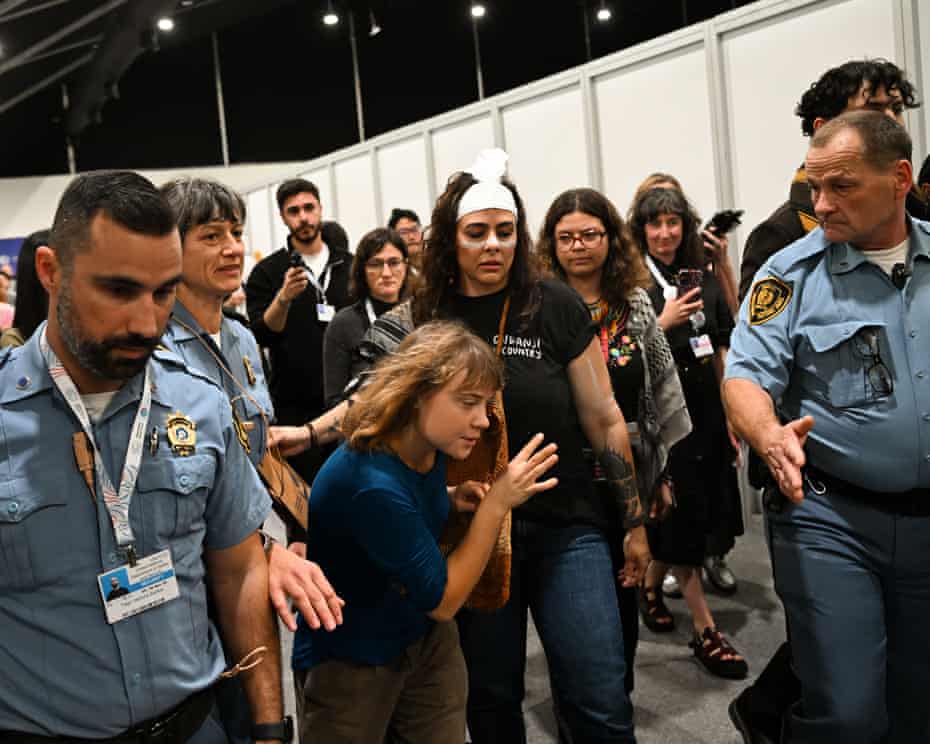
Thunberg criticises governments over climate inaction
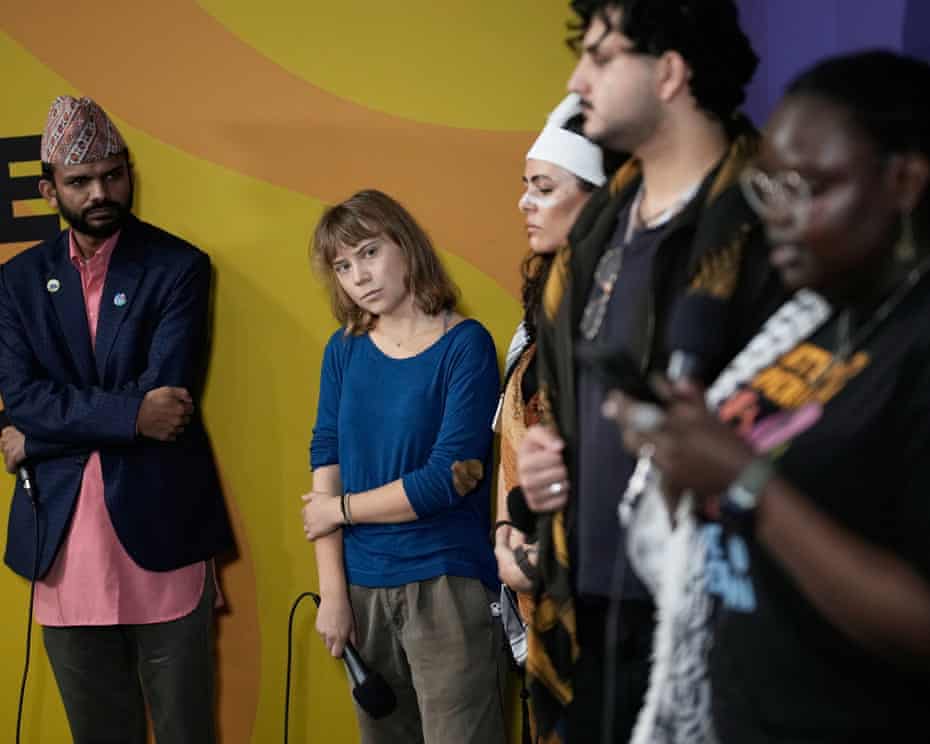
The activist appeared before a packed gathering that included campaigners from Nepal, Australia, Palestine and Canada. Her remarks addressed what she described as the growing failure of governments to control the climate crisis.
She warned that the consequences extended beyond rising temperatures and environmental damage, potentially creating further humanitarian disasters and violations of basic rights.
“We are heading towards a future of more genocides and more ecocides and the complete compromise of our basic rights and where basic necessities become luxuries,” Thunberg said.
She added: “It’s more clear than ever in spaces like these that the situation could not be any less under control, the planet is not dying, it is being killed.”
Thunberg also called for an end to Turkish energy shipments to Israel, arguing that the country’s environmental and political responsibilities could not be separated from the conflict in Palestine.
Her appearance attracted considerable attention from delegates, many of whom crowded around her. She last attended a COP conference in Glasgow in 2021, when she famously dismissed the discussions as “blah, blah, blah”.
Since then, her activism has increasingly included the Palestinian cause alongside her longstanding campaign for climate action.
Palestine and environmental destruction enter summit debate
The conflict in Gaza featured prominently in discussions at COP31, with Palestinian Prime Minister Mohammad Mustafa receiving a standing ovation during his address to delegates.
Mustafa said Palestine remained committed to climate objectives despite the destruction caused by Israel’s military campaign. He appealed to international leaders to support Palestinians and recognise their right to climate justice.
“We still need your support,” he told the gathering.
A day earlier, Turkish President Recep Tayyip Erdoğan had argued that the environmental consequences of the war should be recognised internationally.
“What has taken place in Gaza is not only a genocide, but it is also an ecocide,” Erdoğan said. Israel denies that its actions in Gaza constitute genocide.
Turkey’s decision not to invite Israel to the leaders’ summit also attracted attention. COP31 President Murat Kurum confirmed that Israel had not received an invitation.
“As the host country for the leaders’ summit, we did not send an invitation to Israel,” Kurum told local media, according to The National.
He added that climate justice could not be separated from peace, saying: “Of course, we will discuss the climate and climate justice here. We say that there can be no climate justice where peace does not prevail.”
The Palestinian presence at the conference included a pavilion displaying photographs documenting destruction in Gaza over the past three years. Its exhibition area featured black fabric hanging from the ceiling to resemble refugee tents.
Although Palestinians from the Gaza Strip could not attend because the borders remained sealed by Israel, some joined through video links. Palestinians from the occupied West Bank were present at the summit.
A staff member at the Palestinian pavilion said the intention was to discuss environmental issues rather than politics. However, the destruction of infrastructure, pollution and waste-management challenges in Gaza and the West Bank made separating environmental concerns from the conflict difficult.
Young Caribbean campaigner demands stronger climate commitments
The experiences of vulnerable communities were also highlighted by 28-year-old Josie Ann Le Blanc, a member of the Caribbean Youth Environment Network from the Commonwealth of Dominica.
Le Blanc explained that her commitment to climate advocacy developed after Dominica suffered devastating natural disasters, including Tropical Storm Erika in 2015 and Hurricane Maria in 2017.
The disasters caused deaths, disappearances and widespread homelessness, leaving lasting effects on communities across the island.
“Being born and raised in Dominica, climate change is never far from our minds,” she said.
“Since the storms in 2015 and 2017, we have also been experiencing record-breaking heatwaves, resulting in droughts, water shortages and health concerns for all, especially those who are particularly vulnerable.”
She argued that climate change was influencing everyday life, economic development and public health, rather than being merely an environmental issue.
Le Blanc called for stronger commitments on climate finance, adaptation and compensation for climate-related losses and damage. She also urged decision-makers to ensure that small island developing states and young people had meaningful influence over international climate policies.
“Ultimately, climate action should not only be measured by commitments made on international stages but also by the difference made and what communities can feel in their everyday lives,” she said.
Activists demand accountability from major polluters
Other campaigners at Thunberg’s press conference described the direct consequences of environmental destruction in their communities.
Nepalese lawmaker Sagar Dhakal recalled helping to dig people out of debris following a deadly landslide caused by melting glaciers along the Nepal-Tibet border earlier in 2026.
“I don’t think there are words in the dictionary to describe it,” he said, describing the experience.
He urged developed countries to provide assistance to vulnerable nations, arguing that international cooperation could prevent future disasters.
“If we all work together we can prevent the next disaster,” Dhakal said.
Indigenous Australian campaigner Rikki Dank criticised his country’s continued reliance on fossil fuels and called on Prime Minister Anthony Albanese to listen to communities opposing new extraction projects.
“Our prime minister needs to stop speaking and start listening when we say no to fracking of our country, to stop speaking and start listening when we say no to poisoning of our water and our sacred sites,” Dank said.
“He needs to stop speaking and start listening when the Australian people say no new coal, oil and gas.”
Mohammed Usrof, founder of the Palestinian Institute for Climate Strategy, linked fossil-fuel interests to the destruction of Palestinian communities. He said 20 members of his family had been killed by Israel.
“This militarized fossil economy continues to profiteer off genocide but also the complete devastation of our land,” he said.
“There’s an intentional act of ecocide and environmental devastation.”
Usrof called for Israel to be removed from the United Nations climate framework and the wider United Nations, while urging countries, including Turkey, to stop supplying fuel to the Israeli military.
Canadian activist Celine Isimbi also criticised political leaders for failing to translate their international statements into meaningful assistance.
Born to Rwandan and Democratic Republic of Congo refugees, Isimbi questioned the significance of attendance at climate conferences when affected communities continued to experience disasters.
“Showing up means nothing when families are under rubble, when families have to be rescued from flash flooding,” she said.
She added that leaders must provide the financial resources and practical support communities need.
Developing countries demand climate finance
The Greta Thunberg warning reflected a wider frustration among campaigners and representatives of poorer countries, many of whom argued that nations contributing least to global emissions were suffering some of the worst consequences.
Lesotho’s Deputy Prime Minister, Nthomeng Majara, said her country was experiencing changing rainfall patterns, droughts, floods and land degradation, with serious implications for agriculture and food security.
“Countries that have contributed least to the problem should not bear a disproportionate burden of its consequences,” Majara said.
She called for climate finance that was accessible to vulnerable countries without increasing their debt burdens, insisting that adaptation must become a global priority.
Tonga’s Prime Minister, Fatafehi Fakafanua, urged developed nations to fulfil their responsibilities to reduce emissions and support smaller economies.
“At forums like this, we’ve been told that we ask too much – that our red lines are unreasonable,” he said.
He described the Antalya conference as an opportunity for a turning point and urged participants to act according to their responsibilities.
The Solomon Islands Prime Minister, Matthew Wale, said his country remained in “perpetual climate disaster recovery mode”. It was dealing with the effects of prolonged El Niño conditions while recovering from a category-five cyclone.
Wale called for practical commitments, including published timelines for distributing climate finance and independent monitoring to ensure promised funding reached affected communities.
Lebanese Prime Minister Nawaf Salam also argued that environmental rehabilitation should form part of his country’s recovery from the war with Israel. He said damage to ecosystems and livelihoods could continue for years.
Lebanon wants reconstruction efforts to include restoring agricultural roads, rehabilitating ecosystems and rebuilding livelihoods, alongside respect for its sovereignty and international law.
World leaders face pressure over climate commitments
The summit’s leaders’ speeches repeatedly highlighted disagreements over responsibility, financing and the speed of the global transition away from fossil fuels.
Representatives of poorer countries pressed wealthy nations to provide more financial assistance, while small island states demanded deeper emissions cuts to prevent global warming from exceeding the 1.5°C target.
Several wealthy countries promoted electrification, although relatively few directly criticised fossil fuels.
Russia’s climate envoy, Ruslan Edelgeriyev, argued that natural gas and new technologies would remain important to future energy systems.
He said businesses in Russia were addressing practical energy challenges while political leaders continued debating climate policies. He also defended the right of individual countries to determine their own energy mix.
South Korean climate ambassador Kang Kum-Sil highlighted her country’s electrification efforts despite its continued dependence on coal.
“Cop31 must demonstrate that multilateral cooperation remains an effective means of addressing climate change,” she said.
UK Prime Minister Andy Burnham also addressed the conference, declaring that Britain was ready to contribute to tackling the climate crisis and supporting Turkey’s electrification drive.
However, environmental organisations insisted that speeches and attendance would not be enough.
Oxfam GB climate justice adviser Beth John described Burnham’s appearance as a positive signal but warned that governments must demonstrate results.
“Showing up is not enough: a crisis of this scale needs substantive action, not just signals. The real test of climate leadership is delivery, not declarations,” she said.
War on Want campaigner Leon Sealey-Huggins also questioned whether the summit’s electrification target would address existing inequalities in energy access.
He argued that wealthy countries consumed significantly more energy per person than poorer regions, citing International Energy Agency scenarios showing United States per-capita consumption at five times the level in South Asia and 17 times that of Africa.
He said the electrification target would only be meaningful if countries lacking adequate electricity received the climate finance required to make the transition possible. About 730 million people worldwide still lack access to electricity.
Climate disasters bring urgency to negotiations
The human consequences of climate change were also illustrated by testimony from Canadian excavation company owner Darcy Ruddy, who experienced the devastating Jasper wildfire.
Ruddy had been working at a luxury heliskiing lodge near Valemount in western Canada before the wildfire destroyed parts of Jasper. He had completed approximately 95 per cent of his work and left his machinery at the lodge before returning home to collect a camper van.
He later explained that leaving the machines behind had potentially saved him from losing everything.
As the fire developed, Ruddy received messages from friends reporting lightning strikes and visible flames. One friend working in the parks service was involved in evacuating a campground.
Read more: Scott Colom victory ends decades-long Democratic drought in Mississippi Senate race
https://swiftreportnow.com/scott-colom-victory-ends-decades-long-democrati/
Ruddy recalled the moment he realised the danger had become immediate: “Holy fuck, this is it.”
He subsequently contacted his father, urging him to leave the area and begin preparing for evacuation.
The account formed part of wider evidence presented at the summit about the increasing risks associated with extreme weather and changing climate conditions.
With leaders’ speeches concluded, attention at COP31 is now shifting towards closed-door negotiations. Delegates face pressure to turn their public commitments into measurable decisions on emissions, financing and adaptation.
The conference has exposed continuing divisions between wealthy polluting nations and countries already experiencing severe climate impacts. Activists, meanwhile, insist that communities cannot survive on promises alone.
Thunberg’s central message was that the people responsible for addressing the crisis must be held accountable, while vulnerable communities need practical protection rather than further declarations.
About The Author