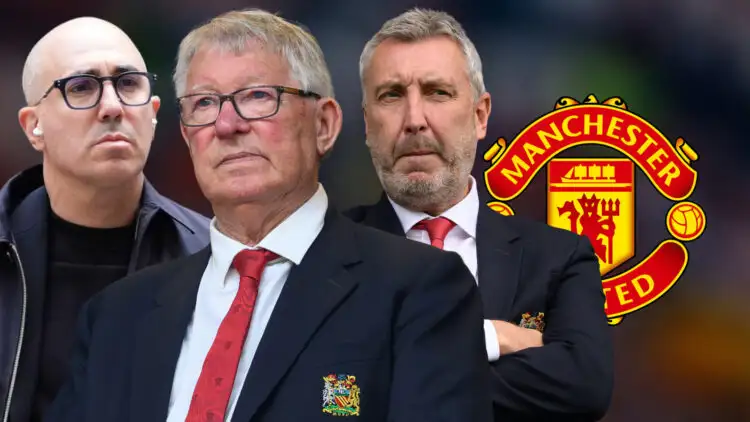
Ferguson on Man Utd transfers has become a major talking point following reports that the legendary former manager challenged Omar Berrada and Jason Wilcox over the club’s recruitment strategy during a September board meeting.
The former Manchester United boss reportedly expressed serious concerns about the club’s transfer decisions, particularly the players recruited during the 2024 summer window. His intervention has renewed scrutiny of the leadership responsible for rebuilding United’s football operations.
Ferguson remains a Global Ambassador at Old Trafford and continues to take a keen interest in the club’s fortunes. Although he retired from management in 2013, his achievements and longstanding connection with United mean his opinions still attract considerable attention.
During his 26 years in charge, he won 24 major trophies, including 13 Premier League titles and two Champions League crowns. His success established United as one of Europe’s leading clubs.
Ferguson challenges Berrada and Wilcox
According to The Athletic, Ferguson raised concerns about United’s transfer strategy during a football board meeting in September.
The discussion reportedly centred mainly on the club’s recruitment activity in 2024, with chief executive Berrada and director of football Wilcox involved in the exchange.
Although the meeting was designed to encourage informal discussions rather than conduct official business, Ferguson’s passion for Manchester United meant that strong opinions could be expressed.
The report described the conversations as robust, suggesting that the former manager was prepared to challenge the club’s current decision-makers over the direction of their recruitment policy.
The development comes amid growing dissatisfaction with United’s performances and the effectiveness of their football administration.
Michael Carrick became the seventh permanent manager to be dismissed since Ferguson’s retirement when the club sacked him on Thursday.
Carrick’s departure followed a disastrous start to the campaign that left United 18th in the table, with only eight points from their opening ten matches.
His dismissal has attracted sympathy from supporters who believe the problems at Old Trafford extend beyond the manager. Carrick had helped restore Champions League football the previous season, making his removal particularly controversial among sections of the fanbase.
The 2024 recruitment window under scrutiny
Ferguson’s reported concerns focused particularly on United’s 2024 transfer business.
The club spent approximately £180 million recruiting Leny Yoro, Manuel Ugarte, Matthijs de Ligt, Joshua Zirkzee and Noussair Mazraoui during that summer.
Those arrivals were expected to strengthen the squad and provide a foundation for sustained improvement. However, United’s subsequent struggles have raised questions about whether the recruitment strategy delivered the quality and balance required.
The following summer produced a different group of signings, with Benjamin Sesko, Matheus Cunha, Bryan Mbeumo and Senne Lammens joining the club.
That window was generally considered more successful, although the club’s decision-makers have continued to face criticism over their transfer dealings.
The wider concern is whether United have consistently managed to secure their preferred targets or have repeatedly settled for alternatives after negotiations became complicated.
Carrick wanted more players than United delivered
The report also revealed that Carrick wanted significantly more reinforcements than the club provided before the current campaign.
In particular, he wanted a backup striker and a left-back to improve the squad’s depth.
Midfield was another priority. Casemiro’s departure and the growing acceptance that Ugarte was unlikely to fulfil expectations made a major rebuild necessary.
However, the midfielders eventually recruited were reportedly far down United’s original shortlist.
Andrey Santos, Carlos Baleba and Youri Tielemans arrived for a combined £150 million, despite the club having considered several other candidates.
Elliot Anderson was reportedly the leading target, followed by Mateus Fernandes, Sandro Tonali, Aurélien Tchouaméni, Alex Scott, Ederson and Ayyoub Bouaddi.
The suggestion that the eventual signings ranked seventh or eighth on the shortlist raises questions about how United arrived at their final decisions.
It also highlights the difficulties the club experienced in translating its recruitment priorities into completed transfers.
United considered Goretzka instead of Tielemans
Another revelation concerned United’s reported interest in Leon Goretzka.
According to The Athletic, the club seriously considered signing the German midfielder as a free agent instead of pursuing Tielemans.
Goretzka eventually joined Aston Villa and scored against Manchester United in Carrick’s final match in charge.
The development provides another example of how United’s recruitment decisions have attracted attention, particularly given the club’s need to strengthen its midfield.
There were also claims that Anderson wanted to join Manchester United but the transfer failed to progress because the club did not approach Nottingham Forest’s valuation.
A separate TeamTalk report suggested that Jason Wilcox failed to come close to the asking price before Manchester City moved to secure the England international for £116 million.
The reported circumstances have intensified criticism of United’s handling of their pursuit of one of their leading midfield targets.
Six-person approval process complicates transfers
United’s recruitment difficulties may also have been affected by the complicated approval structure within the club.
The Athletic reported that agents had experienced problems obtaining clear responses during negotiations because several executives needed to be consulted or convinced.
The individuals involved reportedly include Berrada, Wilcox, Christopher Vivell, the director of recruitment, and Matt Hargreaves, the director of negotiations.
Every transfer must subsequently receive approval from Ratcliffe and the Glazer family.
The report explained:
‘Agents have reported a complicated process in some cases in getting a clear answer from United, with several executives needing to be looped in or convinced. As well as Berrada and Wilcox, there is Christopher Vivell, director of recruitment, and Matt Hargreaves, director of negotiations. All transfers then require ratification from Ratcliffe and the Glazers.’
Such a process could make negotiations unnecessarily difficult, especially when United are competing with other clubs for players who attract significant interest.
A recruitment structure involving several layers of approval may also create uncertainty over who has the final responsibility for identifying targets and completing deals.
Pressure increases on United’s owners and executives
The reported exchange involving Ferguson comes as Manchester United‘s leadership faces increasing criticism.
The Glazer family have been unpopular among sections of the club’s supporters since their leveraged takeover, which saddled United with approximately £600 million in debt.
Read also: Mohammad Javad Vafaei Sani honoured with Magnitsky award as Iran boxer faces execution
https://swiftreportnow.com/mohammad-javad-vafaei-sani-honoured-with/
Ratcliffe has also become a target of criticism despite promising to introduce a best-in-class structure after purchasing a minority stake in February 2024.
Berrada and Wilcox were appointed to important positions as part of the restructuring of United’s football operations. However, their recruitment decisions and the club’s continuing instability have placed their leadership under pressure.
Carrick‘s dismissal has further strengthened the argument that Manchester United need to address deeper organisational problems rather than repeatedly changing managers.
Ferguson’s reported intervention is significant because it suggests that concerns about the club’s recruitment strategy have also reached one of the most influential figures in its history.
United must now establish a more effective transfer structure, improve communication between decision-makers and ensure that their preferred targets can be pursued without unnecessary delays.
The challenge facing Berrada and Wilcox is not simply to appoint another manager or spend more money. They must demonstrate that the club has a coherent recruitment strategy capable of rebuilding a team that can consistently compete at the highest level.
About The Author