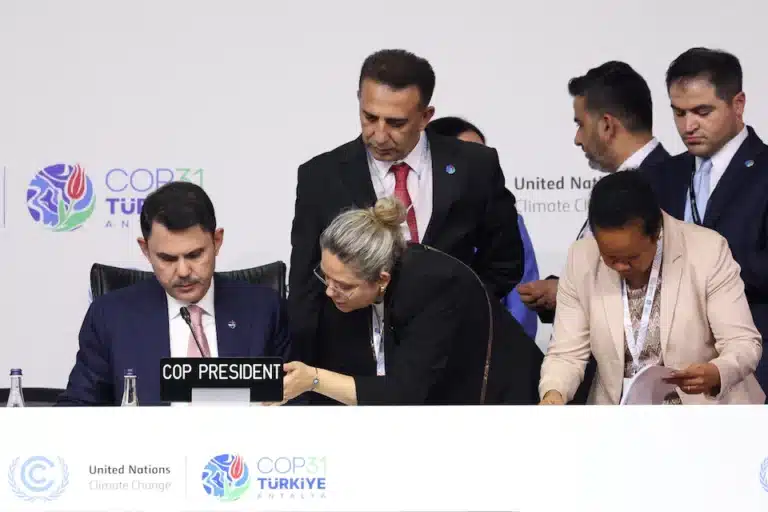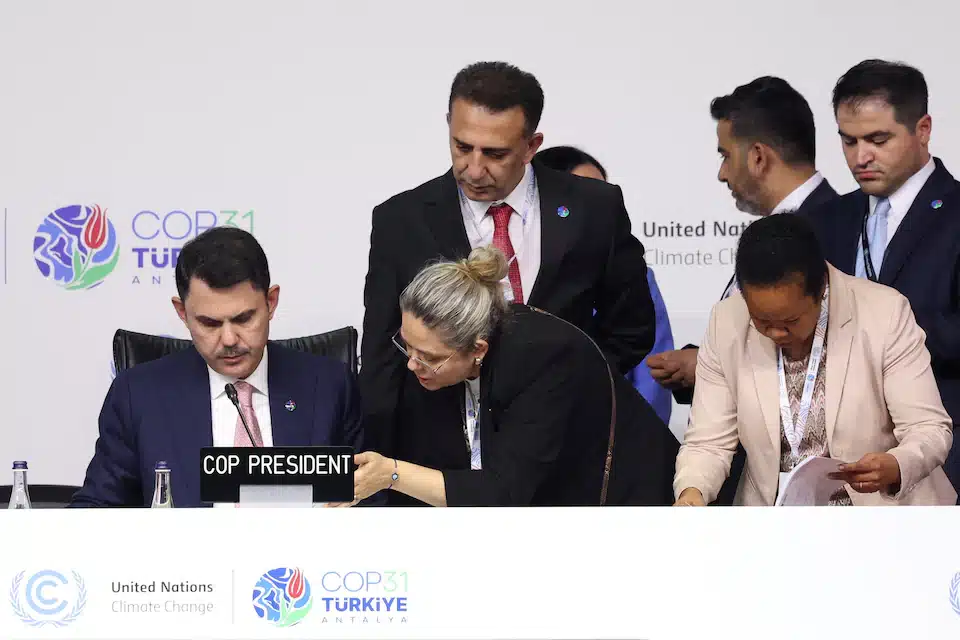
The COP31 climate deal moved closer to approval on Sunday after summit president Murat Kurum presented a revised agreement aimed at securing consensus among nearly 200 countries, despite continuing disagreements over fossil fuels and how to tackle global warming.
The new draft was released in Antalya, Turkey, two days after the United Nations climate conference was originally scheduled to conclude. Australia and Turkey, which are jointly leading the COP31 presidency, hope the latest proposal will provide a compromise acceptable to participating governments.
Kurum told delegates during a plenary session early on Sunday that the presidency believed it had produced a text capable of winning support from all parties. He said the conference would reconvene later in the morning to approve the proposed agreement.
The negotiations have been difficult, with countries divided over the language required to address the continued production and use of coal, oil and natural gas. These fossil fuels are the principal drivers of human-caused climate change.
Although the revised proposal contains language referring to an earlier international commitment to transition away from fossil fuels, it does not explicitly mention coal, oil or gas.
The omission has become one of the most contentious aspects of the negotiations, particularly for environmental organisations and countries demanding stronger commitments to reduce greenhouse gas emissions.
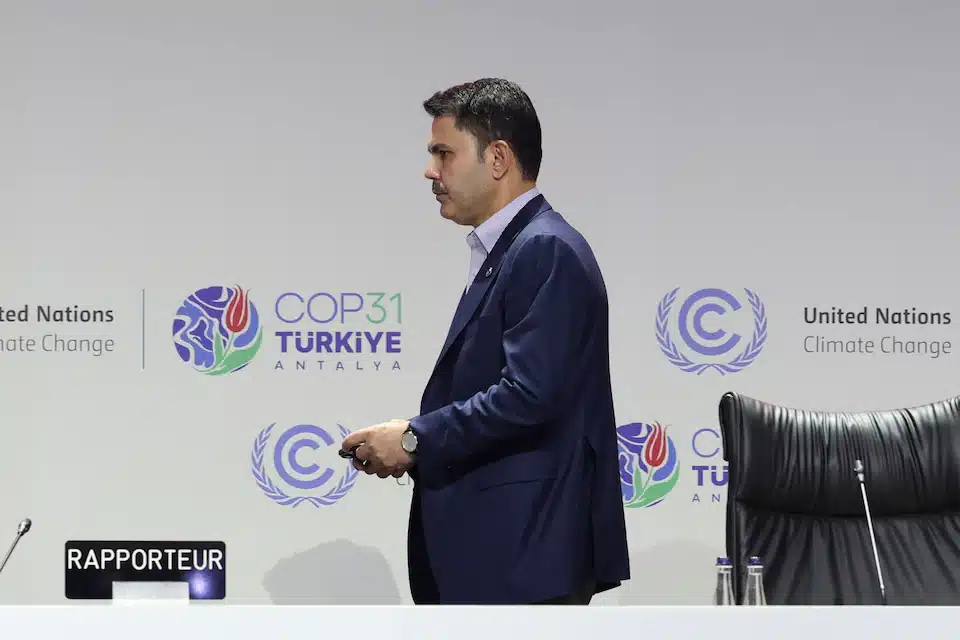
COP31 climate deal acknowledges possible breach of 1.5-degree target
One of the most significant elements of the proposed agreement is its acknowledgement that global warming is on course to exceed the 1.5-degree Celsius threshold established under the Paris climate agreement.
The threshold, equivalent to 2.7 degrees Fahrenheit, represents the temperature limit countries agreed more than a decade ago to try to preserve in order to reduce the most dangerous consequences of climate change.
The latest draft recognises that the world is unlikely to remain within that limit, reflecting growing scientific concerns about the pace of global temperature increases.
However, the proposal also calls for faster development of carbon-removal technologies that could eventually help reverse the temperature overshoot.
Such technologies are designed to remove carbon dioxide from the atmosphere or prevent it from entering the atmosphere in the first place. They include methods that capture emissions from industrial facilities and approaches intended to remove carbon dioxide already present in the air.
The proposal’s emphasis on these technologies has, however, generated criticism from environmental campaigners who argue that carbon removal must not become an excuse for continued fossil fuel development.
Environmental campaigners criticise carbon-removal proposal
Environmental organisation 350.org expressed disappointment with the latest draft, highlighting both its failure to mention fossil fuels explicitly and its encouragement of carbon-removal technologies.
Sara Shaw, the organisation’s campaigns and networks director, described carbon capture as one of the biggest scams of the overshoot era.
She warned that the proposed agreement could encourage governments to place excessive confidence in technologies that capture carbon dioxide instead of prioritising direct reductions in fossil fuel consumption.
Shaw also argued that the draft could create opportunities for additional fossil fuel development, undermining the environmental objectives of the international negotiations.
Her criticism reflects a wider disagreement over whether carbon-removal technologies should play a major role in climate strategies while governments continue to rely heavily on conventional energy sources.
Environmental advocates have consistently called for clearer commitments to reduce fossil fuel production and consumption, arguing that technological solutions cannot replace immediate emissions reductions.
Oil-producing countries oppose explicit fossil fuel language
The absence of a direct reference to fossil fuels in the new proposal has drawn attention to the influence of major oil-producing nations during the negotiations.
Observers familiar with the closed-door discussions told Reuters that Saudi Arabia and other major oil-producing countries had pushed strongly to prevent fossil fuels from appearing explicitly in the agreement.
According to the observers, these countries also supported the inclusion of language promoting carbon removal, an approach that could allow governments to focus on future technological solutions rather than immediate restrictions on fossil fuel production.
A representative of the Saudi delegation declined to comment when approached about the negotiations.
The disagreement highlights the difficulty of reaching international climate agreements involving countries with very different economic interests.
Some governments depend heavily on oil and gas production for national revenue, employment and economic development. Others are particularly vulnerable to rising temperatures, extreme weather, droughts, flooding and rising sea levels.
Countries that consume large quantities of fossil fuels also face difficult decisions about how quickly they can replace existing energy systems without disrupting their economies.
Australia and Turkey seek compromise among nearly 200 countries
The latest draft followed intensive consultations involving Australia, Turkey and delegations representing nearly 200 countries.
Australia has been leading the negotiations, while Turkey is hosting the conference in Antalya and providing the summit presidency under Murat Kurum.
Their responsibility has been to produce an agreement that balances the demands of nations most exposed to climate change with the economic concerns of countries whose industries depend on fossil fuel production or consumption.
The presidency gave participating delegations several hours to raise objections to the proposed text before a session scheduled for 0700 GMT to begin the approval process.
The negotiations have therefore entered a critical stage, with governments expected to decide whether the compromise offers sufficient progress or requires further changes.
Although the new proposal has brought the conference closer to an agreement, the possibility of objections remains significant because the fossil fuel dispute has been central to the discussions.
COP31 negotiations extend beyond scheduled closing date
The delay in reaching an agreement has underlined the divisions among participating governments.
The conference was initially expected to conclude on Friday, but negotiations continued into Sunday as delegates worked to resolve disagreements over the final wording.
The extension reflects the complexity of securing consensus among countries with different economic priorities, environmental responsibilities and levels of vulnerability to climate change.
For nations facing increasingly severe climate-related disasters, the outcome is particularly important because international agreements can influence financial assistance, emissions targets and future cooperation.
Developing countries have repeatedly called for stronger support to help them adapt to climate impacts, while wealthier industrialised nations face pressure to demonstrate that their commitments match the scale of the crisis.
The final agreement is expected to shape discussions on how governments respond to rising temperatures, reduce emissions and support communities already experiencing the consequences of climate change.
However, the absence of an explicit fossil fuel reference could weaken the proposal’s appeal to campaigners who believe that any credible climate agreement must directly address the principal sources of greenhouse gas emissions.
Global temperature projections increase pressure on governments
COP31 is taking place against the backdrop of increasingly concerning scientific assessments about the future of global temperatures.
It is the first climate summit since the United Nations Environment Programme confirmed that global temperatures were expected to exceed the 1.5-degree Celsius threshold within the coming years.
That assessment has increased pressure on governments to strengthen their climate policies and accelerate efforts to reduce emissions.
The 1.5-degree target remains an important benchmark because the risks associated with climate change become more severe as global temperatures rise.
Exceeding the threshold does not mean that efforts to limit warming become meaningless. However, it increases the urgency of reducing emissions and preparing communities for more intense climate impacts.
Governments are also under pressure to ensure that commitments made during international conferences translate into practical domestic policies.
These include expanding renewable energy, improving energy efficiency, protecting forests, reducing industrial emissions and developing infrastructure capable of withstanding extreme weather.
The proposed COP31 climate deal attempts to acknowledge the growing likelihood of a temperature overshoot while encouraging technological development that could help reverse some of its consequences.
Nevertheless, environmental organisations are warning that such commitments must not distract from the immediate need to reduce dependence on fossil fuels.
Final approval remains the next major test
With the revised text presented and the approval process scheduled to begin, attention has shifted to whether participating countries will accept the compromise.
Kurum expressed confidence that the presidency had put forward a proposal capable of securing agreement, but the continuing disagreements suggest that the final stage could remain difficult.
The decision will determine whether COP31 concludes with a consensus document addressing the temperature crisis, even if some of its provisions fall short of campaigners’ expectations.
For Australia and Turkey, securing approval would represent an important diplomatic achievement after prolonged negotiations involving countries with competing economic and environmental interests.
For environmental groups, however, the absence of explicit language on fossil fuels remains a major weakness that could undermine the agreement’s credibility.
The outcome will therefore be judged not only by whether governments approve the document, but also by whether its commitments lead to meaningful reductions in emissions and stronger protection against global warming.
Reuters reported the developments from Antalya, with Tuvan Gumrukcu and Ali Kucukgocmen among the journalists covering the negotiations.
About The Author