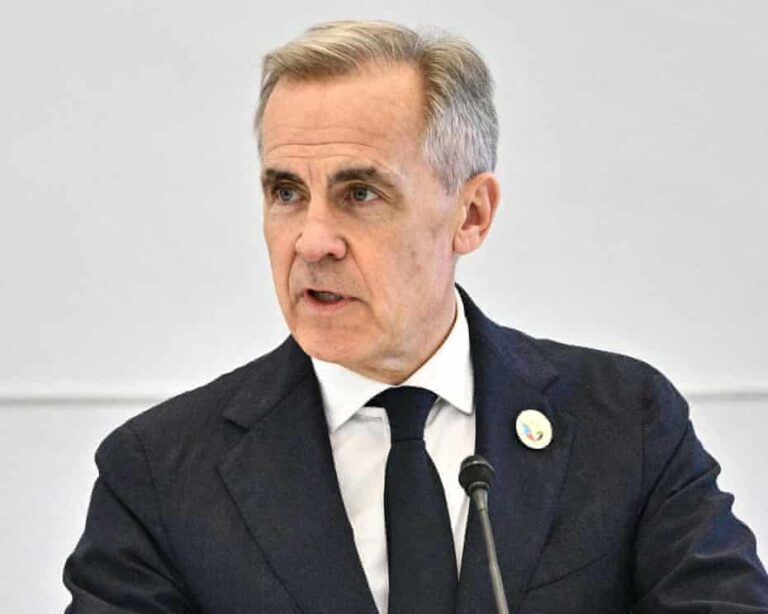
Mark Carney popularity has reached extraordinary levels in Canada, allowing the prime minister to pursue ambitious economic, infrastructure and energy policies with relatively little political resistance. However, questions are emerging about whether his public support can survive if Donald Trump’s trade pressure on Canada eases.
Carney has built an unusual political coalition spanning traditionally opposing political camps, benefiting from public anxiety over American tariffs, threats against Canadian sovereignty and deteriorating relations with Washington.
Since entering politics in 2025, the former central banker has positioned himself as a leader capable of protecting Canada’s economic interests, strengthening domestic industries and reducing the country’s dependence on the United States.
His approach has earned him considerable goodwill, but critics argue that Canadians may be overlooking controversial decisions because of their confidence in his handling of the country’s relationship with Trump.
The Guardian, in a report by Leyland Cecco, examines the extent of Carney’s political influence, the policies he has introduced and whether his popularity could weaken once the extraordinary circumstances surrounding his rise to power begin to disappear.

Trump’s trade war helped strengthen Carney’s political standing
Carney’s political fortunes have been closely connected to Canada’s confrontation with Trump, whose administration has imposed tariffs on important industries while repeatedly threatening Canada’s economic interests and sovereignty.
The tensions have created a rallying point for Canadians who view the prime minister as a defender of the country’s independence and economic future.
Following the United States midterm elections, which saw Trump suffer a significant political setback, Ontario Premier Doug Ford openly celebrated the outcome.
Ford, a prominent critic of American tariffs, described his excitement by saying he had been doing cartwheels down the street, adding humorously that people should imagine a big man performing such stunts.
Carney, however, adopted a more restrained response, consistent with his carefully cultivated image as a leader focused on economic strategy rather than political spectacle.
Unlike some international leaders who negotiated trade agreements with Trump only to face renewed tariff threats, Carney walked away from negotiations with the United States in August.
He questioned Washington’s ability to honour agreements, warning that the American administration’s signature was effectively written in pencil rather than permanently binding.
That decision reinforced his image as a leader unwilling to accept unreliable trade commitments simply to secure an agreement with the American president.
Carney popularity crosses traditional political boundaries
One of the most remarkable aspects of Mark Carney popularity is his ability to attract support from voters who traditionally belong to opposing political camps.
He has reportedly become highly popular in francophone Quebec as well as Alberta, a province historically associated with conservative politics and often politically at odds with Quebec.
His political appeal has extended beyond the Liberal Party’s traditional supporters, allowing him to build a coalition that includes voters from both the left and right.
In April, Carney became the first Canadian prime minister to transform a minority government into a majority administration, attracting lawmakers who crossed the floor from rival parties and benefiting from victories in important byelections.
His international standing has also improved, with Carney increasingly associated with the growing influence of middle powers seeking greater independence from traditional global superpowers.
He has participated in international summits and developed relationships with leaders pursuing similar economic and diplomatic strategies.
Political adviser Scott Reid, a former communications director to ex-prime minister Paul Martin, said Carney’s popularity was different from the traditional honeymoon period enjoyed by newly elected leaders.
Reid said the prime minister was attracting supporters from both sides of the political divide, describing the scale and nature of his popularity as something Canada had not previously witnessed.
However, political analyst Philippe Fournier has expressed scepticism about the extraordinary projections showing how well Carney’s Liberal Party could perform if an election were held immediately.
Fournier described the projections as insane in their scope and said he did not believe them.
Why Carney may avoid an early election
Despite the prime minister’s strong approval ratings, political analysts believe calling an early federal election could carry significant risks.
Carney has presented himself as a leader more interested in macroeconomic policy, trade strategy and national development than political manoeuvring.
An early election could undermine that image and expose his administration to accusations of exploiting public popularity for partisan advantage.
Fournier warned that the Liberals could be perceived as opportunists if they called an election simply because their leader was enjoying strong public support.
He argued that attempting to convert Carney’s popularity into additional parliamentary seats could backfire, potentially provoking voter resistance.
The prime minister’s popularity has nevertheless provided him with considerable political freedom to pursue policies that might ordinarily attract stronger opposition.
His administration has introduced major economic initiatives, increased spending commitments and controversial infrastructure plans, often without facing the level of resistance critics expected.
Pipeline approval raises environmental concerns
Carney’s decision to approve plans for an oil pipeline to Canada’s Pacific coast has become one of the most controversial aspects of his domestic agenda.
The project is intended to strengthen Canada’s energy sector, expand access to international markets and reduce dependence on the United States.
Carney has presented the pipeline as a matter of national sovereignty and economic security rather than simply an ideological commitment to increased oil production.
That framing has helped reduce some of the political resistance traditionally associated with major fossil fuel infrastructure projects.
Former prime minister Stephen Harper previously faced fierce opposition from environmental activists and Indigenous communities over efforts to expand oil and gas production.
Carney’s approach, however, has benefited from the prevailing economic anxiety surrounding Trump’s trade policies and threats against Canada.
Critics argue that the prime minister’s political standing has allowed him to advance projects that would otherwise generate considerably more public debate.
Julia Levin, a senior campaigner with Environmental Defence, said Canadians were understandably anxious about Trump’s threats and had consequently placed considerable trust in Carney.
She warned that voters might not be paying sufficient attention to policies that conflict with some of Canada’s environmental commitments and values.
C$140bn budget spending fuels debate over economic priorities
Carney’s government has also attracted criticism over its willingness to run substantial deficits while pursuing an ambitious spending programme.
In early November, the federal budget announced C$140bn in new spending, with commitments covering housing, roads, bridges, schools, healthcare facilities and water infrastructure in First Nations communities.
The government intends to use windfalls from higher oil prices to support investments aimed at improving living conditions, expanding infrastructure and addressing homelessness.
Carney and his finance minister have also promoted a major tax credit for businesses, expected to cost the government C$36bn in forgone revenue over five years.
Unlike the previous administration under Justin Trudeau, which defended deficits as a means of improving living standards, Carney has presented borrowing as an investment in Canada’s economic future.
His government argues that spending is necessary to address declining productivity, encourage private-sector investment, strengthen manufacturing and reduce the country’s dependence on the United States.
However, the scale of the financial commitments has raised questions about whether the government can achieve its objectives without creating additional economic and fiscal pressures.
Environmental policies and workers’ rights face criticism
Carney’s domestic agenda has also attracted criticism over legislation intended to accelerate major infrastructure developments.
Bill C-39 seeks to speed up the approval of large projects, but environmental campaigners fear that the legislation could weaken regulatory protections and reduce the time available for environmental assessments.
Nearly 60 scientists from the Royal Society of Canada have warned that rushing reviews could result in costly and potentially irreversible environmental damage.
Canada is also reportedly falling behind its targets for reducing greenhouse gas emissions by 2030 and 2035.
The government’s decision to cancel the consumer carbon tax and suspend requirements for electric vehicles to account for a greater proportion of future automobile sales has raised further concerns about its environmental commitments.
An environmental commissioner also reported that the government abandoned work in 2024 on its pledge to ban exports of thermal coal.
Labour organisations have criticised proposed rules that could give the labour minister powers to intervene in work stoppages and restrict strike actions affecting certain workers.
Carney has also introduced the possibility of selling parts of Canada’s four largest airports, a proposal that has historically attracted political controversy.
These decisions have generated criticism from groups that believe the prime minister is using his political capital to advance policies that would ordinarily face greater resistance.
Will Carney’s popularity survive the end of Trump’s trade war?
The biggest uncertainty surrounding Carney’s political future is whether his popularity is tied primarily to the extraordinary circumstances that brought him to power.
Trump’s tariff threats, trade disputes and rhetoric about Canada’s sovereignty have helped create a political environment in which Carney is viewed as a national defender.
Political adviser Scott Reid questioned whether the prime minister could maintain his domestic appeal if Trump disappeared from the political equation or the trade war ended.
He suggested that Carney’s popularity could be vulnerable if the circumstances that helped create his unusual political career were no longer present.
For now, the prime minister continues to enjoy considerable public trust, giving him room to pursue policies that supporters might previously have questioned.
However, Levin warned that some Canadians were increasingly attempting to justify government decisions that were not included in Carney’s election platform simply because they trusted him.
Read also: Basra power station fire kills four and injures 35 in southern Iraq
https://swiftreportnow.com/basra-power-station-fire-kills-four-and-injures/
She argued that there were limits to that trust, suggesting the prime minister could eventually face stronger scrutiny over his policies.
Carney’s political strength remains formidable, but the sustainability of his popularity may ultimately depend on whether Canadians continue to view his decisions as necessary responses to external threats or begin judging them independently of the Trump administration’s actions.
About The Author