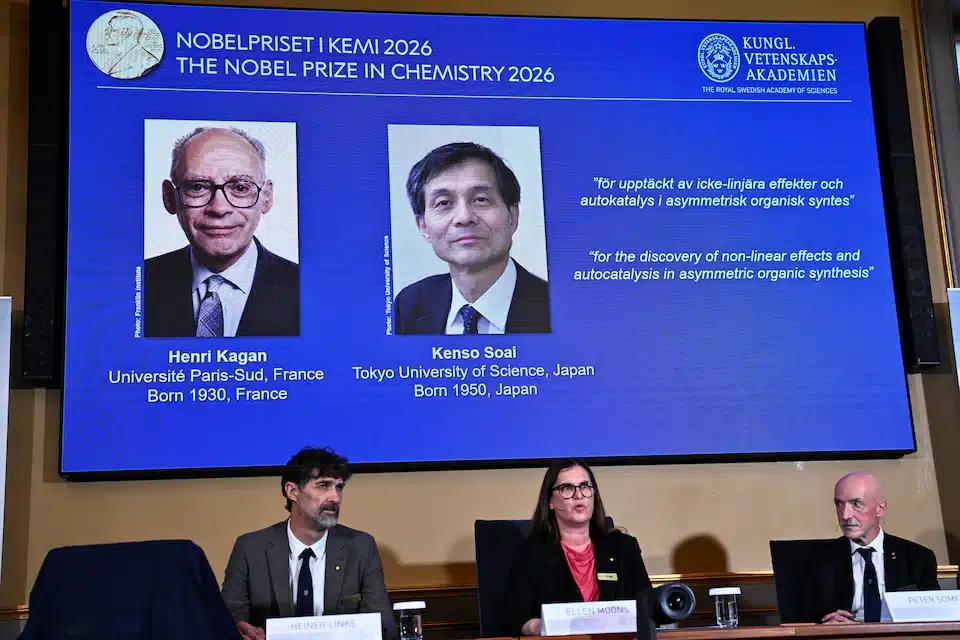
The 2026 Nobel Chemistry Prize has been awarded to Henri Kagan and Kenso Soai for solving the mystery of mirror-image molecules, a breakthrough that has transformed the way scientists develop medicines and manufacture pharmaceuticals.
French scientist Henri Kagan, 95, and Japanese scientist Kenso Soai, 76, were honoured on Wednesday by the Royal Swedish Academy of Sciences for discoveries that helped chemists control which version of a mirror-image molecule is produced during a chemical reaction.
Their work addressed a problem that had puzzled scientists for more than a century and built on pioneering observations made by French chemist Louis Pasteur in the 19th century.
The discovery is particularly important to pharmaceutical manufacturing because two molecules can have the same chemical composition but exist in different spatial arrangements, much like a person’s left and right hands.
Those mirror-image forms can behave differently inside the human body, meaning that producing the correct version of a drug can be crucial for both effectiveness and safety.
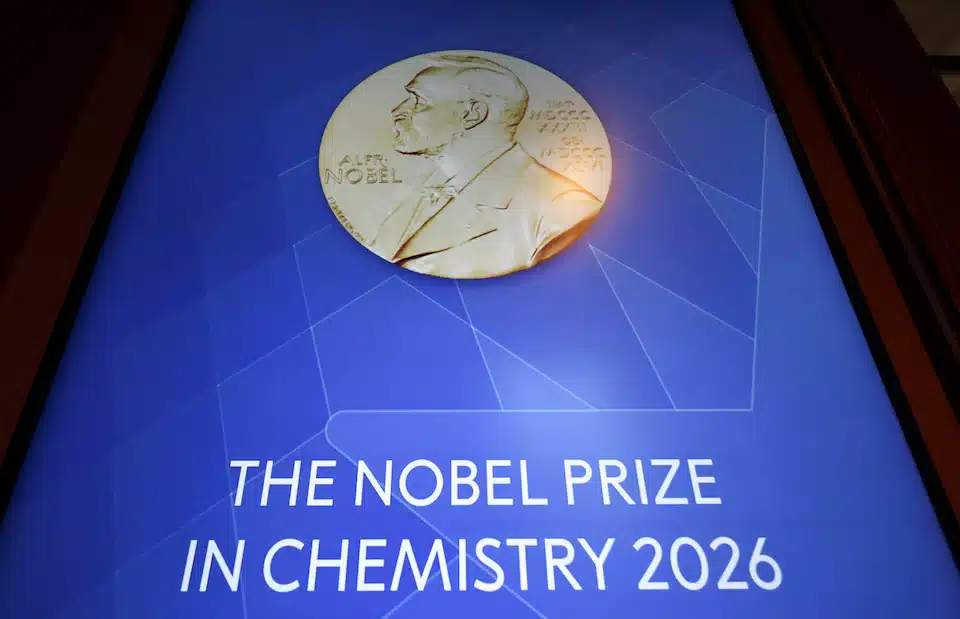
Why the 2026 Nobel Chemistry Prize matters
The 2026 Nobel Chemistry Prize recognises work that enabled scientists to make chemical reactions favour one particular molecular mirror image rather than producing an equal mixture of both.
This phenomenon is known as chirality, from the Greek word for hand, while the dominance of one molecular form in living organisms is known as homochirality.
Peter Somfai, a member of the Nobel Committee for Chemistry, explained why controlling these molecular forms is so important in medicine.
“The left-handed version of the drug can have one effect, and the right-handed version can have another effect, and then we need methods for selectively preparing them,” Somfai said.
He added that the laureates had provided powerful tools for developing methods to selectively prepare the desired molecular form.
The breakthrough has therefore become an important foundation for modern chemistry, particularly in the development and production of pharmaceutical drugs.
The mystery of left-handed and right-handed molecules
Many molecules essential to life exist in two forms that are mirror images of one another.
Although the two versions can appear almost identical chemically, their three-dimensional structures can cause them to interact differently with biological systems.
This is similar to the relationship between a left hand and a right hand. They contain the same basic components but cannot be perfectly superimposed on each other.
Scientists have known about this phenomenon for more than a century, but controlling which molecular form is produced during a chemical reaction remained a major challenge.
Kagan and Soai’s work helped solve that problem by developing asymmetric reactions capable of creating an excess of one molecular form.
That ability gives chemists much greater control when designing substances for use in medicines and other applications.
Building on Louis Pasteur’s discovery
The story behind the 2026 Nobel Chemistry Prize goes back to Louis Pasteur, who made an important observation while studying tartaric acid.
Pasteur examined the substance, which is important in winemaking, and discovered that bacteria fermented only one of its two forms.
The form naturally found in grapes behaved differently from its mirror-image counterpart.
His work demonstrated that some substances could exist in two molecular forms with different properties.
That discovery laid the groundwork for later generations of scientists investigating chirality and the behaviour of mirror-image molecules.
However, knowing that the two forms existed was only part of the problem.
Scientists still needed reliable methods for deliberately producing one preferred form rather than ending up with a mixture.
Kagan and Soai’s research helped provide the tools required to make that selective production possible.
Connection to the thalidomide tragedy
The importance of controlling molecular handedness became especially clear during the thalidomide scandal of the early 1960s.
Thalidomide was prescribed as a sedative and was taken by pregnant women in several countries.
Thousands of children were subsequently born with severe birth defects linked to the drug.
Researchers studying the tragedy discovered that the different molecular forms of the substance had different biological effects, highlighting the potentially serious consequences of failing to understand and control molecular structure.
The episode became one of the most powerful examples of why pharmaceutical chemistry must carefully consider the three-dimensional arrangement of molecules.
The work recognised by this year’s Nobel Chemistry Prize represents an important part of the scientific progress that allows researchers to approach such problems with far greater precision.
Kagan and Soai share prestigious award
Soai said he learned about the Nobel award while he was out shopping.
“This is the most exciting day in my life, I am very glad to share this prize with professor Henri Kagan,” Soai said during the Nobel Prize press conference by telephone.
The Nobel committee was still attempting to contact Kagan when the award was announced.
Kagan and Soai will share the 2026 Nobel Prize in Chemistry and receive their medals at a ceremony in Stockholm on December 10, the anniversary of Alfred Nobel’s death.
They will also share prize money of 12 million Swedish crowns, equivalent to about $1.2 million.
The chemistry award is the third Nobel Prize announced during this year’s Nobel week, following the medicine prize on Monday and the physics prize on Tuesday.
The peace prize will be announced separately in Oslo, as it is the only Nobel award presented outside Sweden.
A century-old chemistry question finally answered
The 2026 Nobel Chemistry Prize highlights how a fundamental question in chemistry can eventually lead to practical applications with major consequences for modern medicine.
The mystery of why mirror-image molecules can behave differently began with Pasteur’s 19th-century experiments and continued through generations of chemical research.
Kagan and Soai helped turn that understanding into practical methods for controlling asymmetric chemical reactions.
Read also: North Korea backs China on Taiwan as Kim pledges support for Russia
https://swiftreportnow.com/north-korea-backs-china-on-taiwan-as-kim-pledge/
Their findings have given pharmaceutical researchers greater control over the production of molecules used in medicines, allowing them to focus on producing the form with the desired biological effect.
The recognition also demonstrates the connection between fundamental scientific discoveries and technologies that eventually become essential to everyday life.
From Pasteur’s observations of tartaric acid to the sophisticated production of modern pharmaceuticals, the scientific journey behind this year’s chemistry Nobel spans more than a century.
The 2026 Nobel Chemistry Prize therefore honours not simply a solution to an abstract chemical puzzle, but a breakthrough that has helped make the manufacture of medicines more precise and potentially safer.