North Korea backs China on Taiwan while Kim Jong Un pledges continued support for Russia, warning the United States over military assistance to Taiwan and deepening Pyongyang’s strategic ties with Moscow and Beijing.
North Korea has criticised US arms sales and military support for Taiwan, accusing Washington of increasing tensions in the Taiwan Strait as Pyongyang simultaneously reaffirmed its backing for Russia.
The comments came after Taiwan received the first two of 66 new US-made F-16V Block 70 fighter jets ordered in 2019, adding another layer to the increasingly complex security rivalry involving the United States, China, North Korea and Russia.
A commentary carried by North Korea’s state news agency KCNA said Washington’s Taiwan policy was undermining peace and stability in the region.
The commentary, attributed to North Korean international affairs analyst Kim Myong Chol, specifically condemned the arrival of US-supplied fighter aircraft in Taiwan.
The analyst warned that the United States should carefully consider the consequences of confronting China over Taiwan.
“The US ‘should think twice whether it is ready to stand in frontal confrontation with the powerful national power of the People’s Republic of China for the security of Taiwan and whether it can cope with its consequences,’” the commentary said.
The warning comes at a sensitive moment for Taiwan, which is seeking to strengthen its defences as Beijing continues to claim the democratically governed island as part of China.
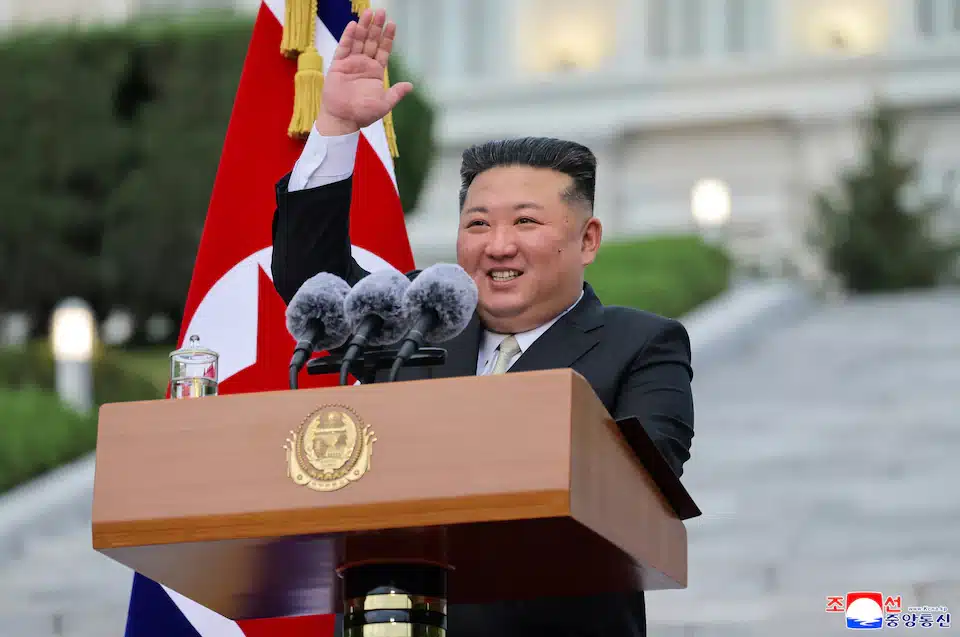
North Korea backs China on Taiwan
North Korea backs China on Taiwan in a position that has become increasingly explicit under Kim Jong Un, particularly following his June summit with Chinese President Xi Jinping.
During that meeting in Pyongyang, Kim told Xi that North Korea would fully support the “One China” principle, which Beijing interprets as meaning that both sides of the Taiwan Strait belong to one country.
The United States, however, has continued to provide defensive weapons to Taiwan despite having no formal diplomatic relationship with Taipei.
Washington is legally committed to providing Taiwan with the means to defend itself, while Beijing has repeatedly demanded that the United States stop supplying weapons to the island.
Taiwan received its first two new F-16V Block 70 aircraft last week from a broader order for 66 jets. The $8 billion purchase, agreed in 2019, is intended to strengthen Taiwan’s air capabilities amid growing military pressure from China.
The arrival of the aircraft provided the immediate backdrop for Pyongyang’s latest criticism of Washington.
The KCNA commentary argued that US military assistance was contributing to instability and warned against any American confrontation with China over Taiwan.
Kim’s warning to Washington
The North Korean position represents a significant diplomatic alignment with Beijing on one of China’s most sensitive foreign-policy issues.
China regards Taiwan as a core national interest and has repeatedly opposed military assistance to Taipei. Taiwan rejects Beijing’s sovereignty claim and says China has no right to represent the island internationally.
North Korea’s increasingly direct support for Beijing therefore places Pyongyang closer to China on the Taiwan question at a time when its own military and strategic relationships with Russia are also expanding.
Analysts have previously noted that North Korea has demonstrated a willingness to provide material wartime assistance to Russia, particularly through its involvement in the Ukraine conflict.
That support has included the deployment of North Korean troops to Russia, according to Ukrainian and South Korean estimates.
Reuters reported that North Korea has sent an estimated 14,000 to 15,000 troops to support Russia’s war in Ukraine since 2024.
Kim pledges continued support for Russia
Alongside the criticism of Washington over Taiwan, Kim Jong Un pledged continued support for Russia in a birthday message to President Vladimir Putin.
According to KCNA, Kim said Pyongyang would continue joint work with Moscow under their comprehensive strategic partnership.
Kim also said he was convinced that Russia’s “sacred war of justice” to defend its sovereignty, security interests and territorial integrity would end in victory.
The message did not explicitly refer to Russia’s war in Ukraine, but its language reinforced the increasingly close relationship between Pyongyang and Moscow.
North Korea and Russia significantly strengthened their military and political relationship after Kim and Putin signed a mutual defence pact in June 2024.
The partnership has since expanded beyond diplomatic statements, with North Korea accused by Ukraine and Western governments of supplying Russia with weapons and personnel for the war.
Ukraine has also said Russia may be providing military technology to North Korea in return.
Ukrainian President Volodymyr Zelenskiy said earlier this month that he believed Russia had shared jet-powered drone technology with North Korea. Reuters reported that Kyiv believes Moscow may be reciprocating for North Korean military assistance, although Zelenskiy said he was less certain about whether Russia had transferred ballistic missile technology.
The development has raised wider concerns because North Korea has continued expanding its missile and military capabilities while deepening its relationships with both Russia and China.
China and Russia ties reshape North Korea’s strategy
North Korea’s simultaneous alignment with China on Taiwan and Russia over the Ukraine war highlights the increasingly important role Pyongyang is playing in a broader geopolitical contest with the United States and its allies.
The relationships are not identical.
With China, North Korea has reaffirmed the “One China” principle and moved to strengthen diplomatic, military and law-enforcement exchanges.
With Russia, Pyongyang has developed a more extensive strategic partnership that includes a mutual defence agreement and wartime military cooperation.
During the June summit between Xi and Kim, China said the two countries would enhance exchanges in diplomacy, law enforcement, military affairs and other areas.
Beijing remains North Korea’s treaty ally and has also repeatedly demanded an end to US arms sales to Taiwan.
The combination of those relationships means that developments involving Taiwan, Ukraine and the Korean Peninsula are becoming increasingly interconnected.
A broader challenge for the United States
For Washington, North Korea’s latest statements add another complication to an already difficult regional security environment.
The United States is supporting Taiwan’s military capabilities while maintaining alliances with South Korea and Japan. At the same time, Washington and its allies are closely monitoring North Korea’s growing military cooperation with Russia.
Read also: Trump Los Angeles San Diego remark sparks backlash as White House defends Iran warning
https://ireport247news.com/trump-los-angeles-san-diego-remark-sparks-ba/
North Korea’s latest warning also comes after Taiwan began receiving the advanced F-16V aircraft, which are equipped with upgraded avionics, radar and weapons systems designed to improve the island’s ability to respond to potential Chinese military action.
Pyongyang’s message therefore goes beyond criticism of a weapons sale. It directly challenges the United States over its willingness to defend Taiwan and warns of the potential consequences of a confrontation with China.
At the same time, Kim’s message to Putin demonstrates that North Korea is maintaining its commitment to Moscow.
Together, the two developments underline how Pyongyang is positioning itself within an increasingly divided international security landscape, with stronger relationships with both China and Russia while continuing to oppose US policy in Asia.
For now, North Korea’s statements do not establish that Pyongyang would become directly involved in a conflict over Taiwan. However, its explicit backing for Beijing’s position and continued support for Moscow demonstrate the increasingly interconnected security relationships surrounding the United States, China, Russia and their respective partners.