The Houthi attack on Aden airport has escalated fighting in Yemen, with ballistic missiles and explosive-laden drones targeting the international airport as Saudi-backed government forces battle to regain territory near the strategic Bab el-Mandeb Strait.
The attack came as Yemen’s Saudi-backed government forces, supported by Saudi-led coalition air power, launched a counter-offensive against the Iran-aligned Houthis in areas surrounding the crucial shipping route.
One missile landed near the runway at Aden International Airport just minutes before a passenger flight from Cairo was due to arrive, according to Yemen’s Transport Ministry.
Authorities cancelled the landing and diverted the aircraft to Jeddah, Saudi Arabia, while two other aircraft on the runway were moved away from the area because of fears of further attacks.
The Houthis did not immediately comment on the reported strike on Aden airport.
Houthi attack on Aden airport disrupts flights
The Houthi attack on Aden airport highlights the expanding scope of the renewed conflict in Yemen, where airports, military facilities and strategic infrastructure have increasingly become targets.
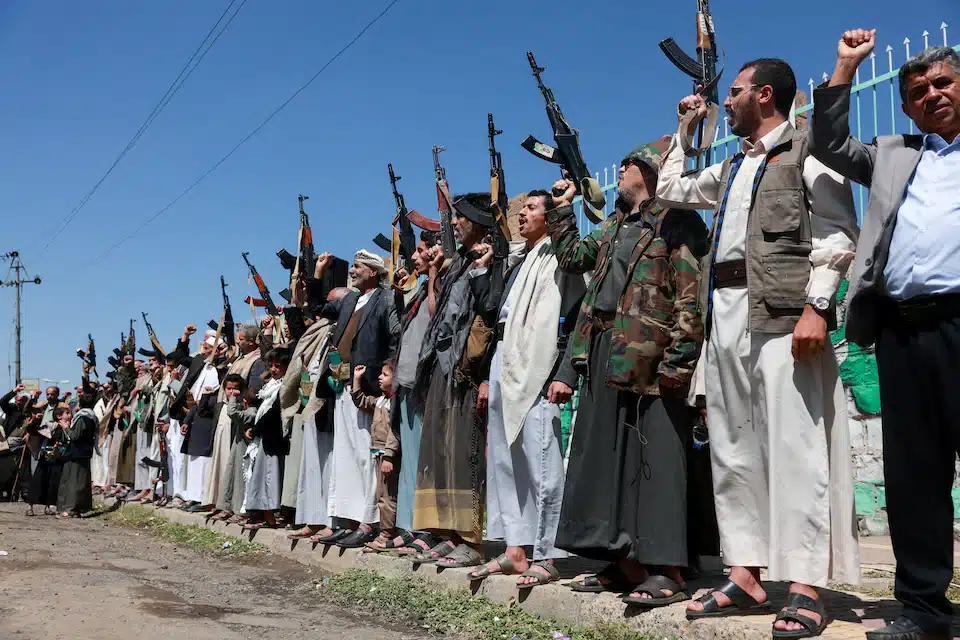
Aden International Airport serves as the main international gateway for areas of Yemen outside Houthi control, making any attack on the facility particularly significant.
The missile strike occurred as fighting intensified on several fronts across the country.
The latest escalation is linked to a broader struggle over territory surrounding the Bab el-Mandeb Strait, one of the world’s most important maritime chokepoints.
The waterway connects the Red Sea with the Gulf of Aden and the wider Indian Ocean, making control of territory around it strategically important for regional security and international shipping.
The importance of the strait has increased further because the wider US-Iran conflict has disrupted trade through the Strait of Hormuz.
Battle for Bab el-Mandeb intensifies
Yemeni government forces supported by Saudi-led coalition air power launched a counter-offensive this week to recapture strategic territory near Bab el-Mandeb and around Mocha.
The Houthis had captured some of those areas in September, prompting government forces to attempt to reverse their gains.
However, it remains unclear whether the government forces will be able to maintain their advance.
Fighting on the western front has concentrated around Dhubab, overlooking the Bab el-Mandeb Strait.
Yemeni military and government sources said pro-government forces were attempting to capture strategic high ground east of the coastal plain.
The Houthis have claimed that they repelled attacks by government forces.
Hussam Radman, a researcher at the Sanaa Center, said the Giants Brigade and other pro-government forces were seeking to take control of Dhubab and advance into the mountains.
Control of the highlands would potentially allow government forces to move more easily along the coast, according to Radman.
Why the Bab el-Mandeb Strait matters
The battle has implications far beyond Yemen because any Houthi attempt to establish a stranglehold around the Bab el-Mandeb Strait could threaten commercial shipping and global energy flows.

The waterway is particularly important because it provides a maritime link between the Red Sea and the Gulf of Aden.
Any prolonged disruption could force vessels to take longer alternative routes, increasing shipping times, insurance costs and pressure on global supply chains.
Saudi Arabia has therefore been seeking international assistance as it attempts to prevent the Houthis from consolidating their position near the strait.
Turkey is providing mainly defensive and technical assistance to Saudi Arabia, according to two officials cited by Reuters.
The development follows a new defence relationship involving Saudi Arabia, Turkey and Pakistan as regional tensions have intensified.
Saudi Arabia intercepts Houthi missiles
The escalating fighting has also spilled beyond Yemen’s borders.
Saudi Arabia’s Saudi-led coalition said on Wednesday that it had intercepted and destroyed a Houthi ballistic missile north of Riyadh.
The coalition said it was tracking the launch platform in Houthi-controlled Sanaa and would destroy it, although it did not immediately provide details about casualties or damage.
Houthi military spokesperson Yahya Saree separately claimed that the group had targeted King Khalid International Airport in Riyadh with several drones.
There was no immediate confirmation from Saudi authorities that the airport had been attacked.
The Houthis also claimed attacks on Abha International Airport and an airbase in Khamis Mushait using ballistic missiles and drones.
Saudi authorities did not immediately confirm the reported attack on Abha airport.
The competing claims underline the intensity of the latest confrontation and the difficulty of independently verifying battlefield reports.
Yemen crisis worsens as thousands flee
The military escalation is also deepening an already severe humanitarian crisis.
The latest fighting has displaced more than 200,000 people, according to the International Organization for Migration.
IOM Director General Amy Pope warned that civilians were struggling to find safe places to escape the violence.
“People are running for their lives and finding nowhere safe to go,” Pope said, while calling for increased funding to provide food and shelter.
The humanitarian consequences are particularly serious in a country that has endured more than a decade of conflict.
The United Nations says three in four families are going hungry in parts of Yemen as fighting, displacement and economic hardship continue to undermine access to food.
Both sides have alleged that hundreds of people have been killed in the latest fighting, although detailed casualty figures have not been provided.
The renewed violence has therefore added another layer of suffering to one of the world’s longest-running humanitarian emergencies.
How Yemen returned to war
The current fighting is part of a conflict that has repeatedly drawn in regional powers.
The Houthis seized Yemen’s capital, Sanaa, in 2014 and subsequently expanded their control over much of the country’s north.
Saudi Arabia, concerned about Iran’s influence along its southern border, intervened through a military coalition.
The conflict eventually produced a UN-brokered truce in 2022 that largely halted the most intense fighting.
However, the truce failed to produce a permanent political settlement.
The Houthis remain in control of large parts of northern Yemen, while the internationally recognised government and allied forces control areas including Aden.
Saudi Arabia and its allies accuse Iran of providing weapons, training and financial support to the Houthis.
The Houthis reject the description of themselves as part of an Iranian proxy network and maintain that they develop their own weapons.
Iran has also rejected accusations that it arms and supports the group.
US-Iran war adds new pressure
The latest Yemen escalation is taking place against the backdrop of a wider US-Iran conflict that has dramatically changed the strategic environment across the Middle East.
Read also: 2026 Nobel Chemistry prize goes to Henri Kagan and Kenso Soai for solving mirror-image molecule mystery
https://swiftreportnow.com/2026-nobel-chemistry-prize-goes-to-henri-kag/
The disruption to shipping through the Strait of Hormuz has increased the importance of alternative maritime routes, including the Bab el-Mandeb.
That has raised the stakes of the fighting along Yemen’s western coast.
Any sustained Houthi control or military pressure around the strait could create additional risks for commercial vessels and energy shipments at a time when global markets are already dealing with disruptions elsewhere.
For Saudi Arabia and its allies, preventing the Houthis from consolidating their gains near Bab el-Mandeb has therefore become a major security priority.
For the Houthis, the latest battlefield gains and missile and drone attacks demonstrate their continued ability to threaten strategic infrastructure despite years of military pressure.
The Houthi attack on Aden airport has now brought that confrontation directly into Yemen’s civilian aviation network, forcing flights to divert and raising fresh concerns about the safety of passengers and airport workers.
With government forces attempting to push the Houthis back from the Bab el-Mandeb area and the group continuing to launch missile and drone attacks, Yemen’s renewed conflict threatens to become another major flashpoint in the wider Middle East crisis.