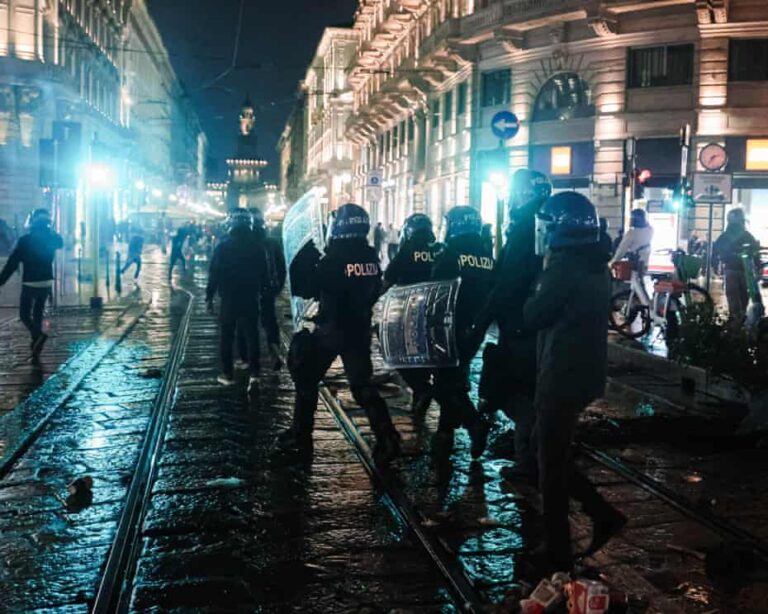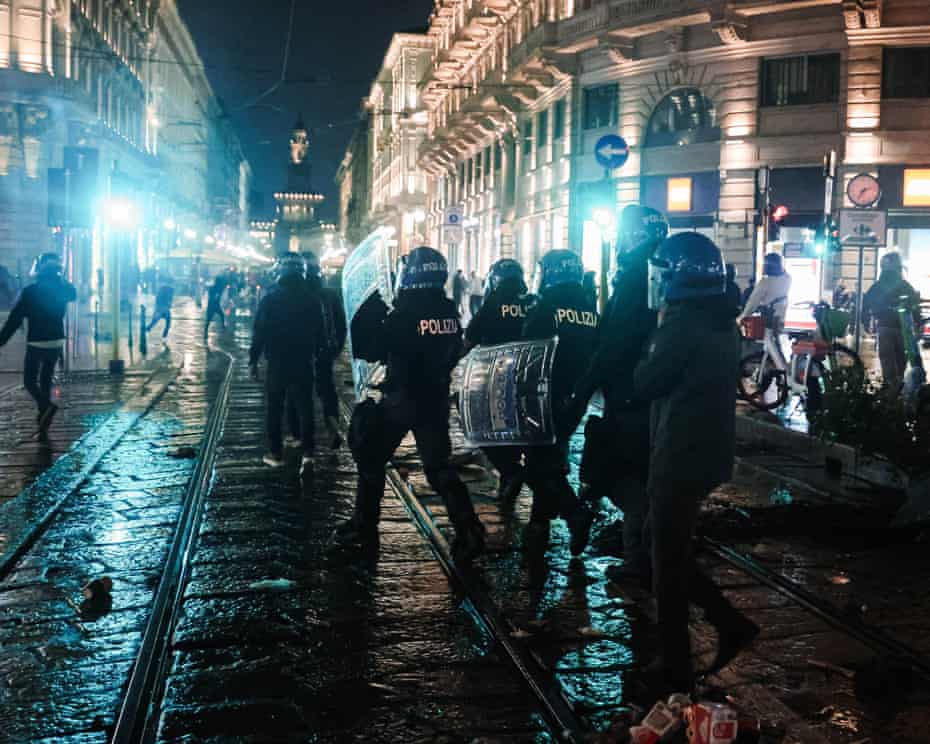
France unrest escalated on Saturday as police clashed with masked rioters in Paris, Marseille and other cities following nationwide demonstrations against rising living costs, deteriorating public services and widening inequality. The interior ministry reported 565 arrests as violence erupted after largely peaceful marches.
An estimated 320,000 people participated in the demonstrations on 31 October, according to France’s interior ministry. Although most gatherings remained peaceful, confrontations broke out in several cities as evening approached, forcing security forces to deploy teargas, stun grenades and water cannon.
The demonstrations brought together students, trade unions and supporters of the gilets jaunes, or yellow vests, movement. Their grievances included the rising cost of living, economic inequality and dissatisfaction with President Emmanuel Macron’s government.
Interior Minister Laurent Nuñez said approximately 150 planned demonstrations had proceeded peacefully but condemned the violence that followed some rallies.
He described the level of violence encountered by police as “extraordinary” and said a riot officer in Paris had been hit by a Molotov cocktail, which he called an “attempted murder”.
“We are fully prepared for those looking for confrontation tonight,” Nuñez warned.
France unrest leaves police confronting masked rioters
Paris became a major flashpoint as a demonstration that began peacefully descended into confrontations between police and masked individuals dressed in blac wek.
The march started at Porte de Bagnolet, near the capital’s ring road, with demonstrators carrying placards criticising government policies and expressing frustration over economic hardship.
One placard read, “No need for teargas to make our future look bleak”, while another stated, “Disguised as an angry citizen for Halloween”.
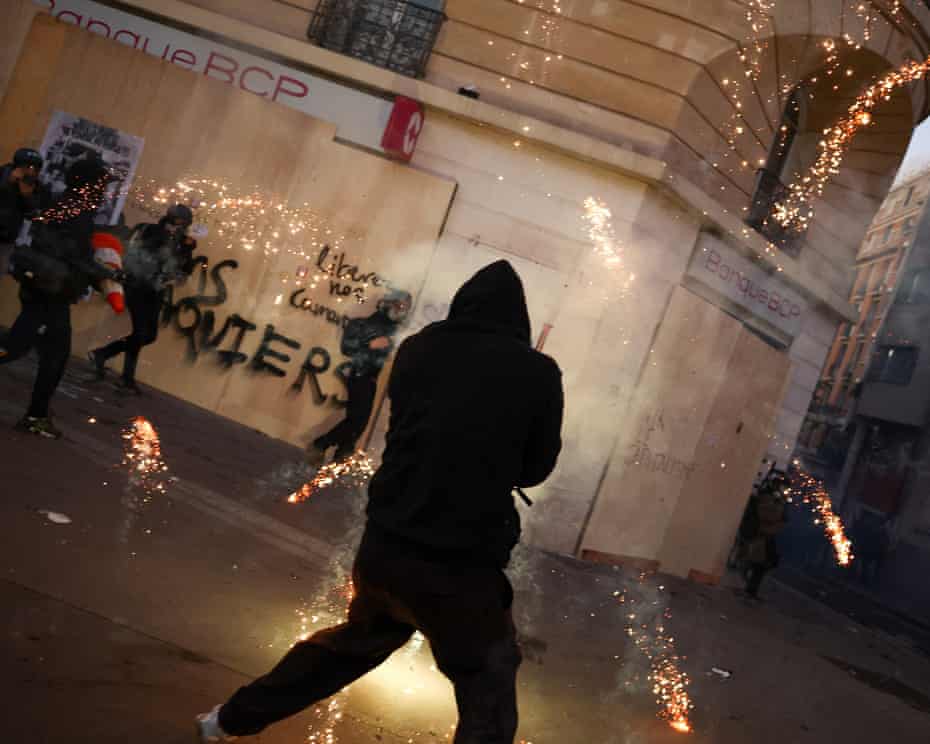
However, disorder broke out around Porte de Charenton as the march approached its destination. Dozens of masked individuals reportedly used hammers to prise up paving stones and throw them at police officers.
At least one incendiary device was also thrown at security forces, prompting police to respond with teargas and baton charges.
The Paris police prefecture described the attackers as “a hardcore of several hundred rioters” who had targeted officers with projectiles.
It said officers had “manoeuvred to restore public order” during the confrontation.
The interior ministry reported 565 arrests across France by late Saturday. Four police officers and one gendarme were also injured in Paris.
The violence revived concerns about the country’s ability to contain unrest following earlier demonstrations that resulted in widespread street violence and looting.
Rising living costs fuel public anger
Economic hardship remained a central issue for demonstrators, many of whom accused the government of failing to address the difficulties faced by ordinary households.
The protests attracted approximately 320,000 participants nationwide, fewer than the estimated 410,000 who demonstrated the previous weekend. Paris alone recorded about 70,000 participants.
The movement united people from different backgrounds around concerns about affordability, inequality and the quality of public services.
Jérôme Rodrigues, a protester who participated in the Paris march, criticised the government’s handling of the economy.
“The French economy is doing badly no matter what happens, because today we’re being run by a group of incompetents who juggle billions while families are struggling with a few cents,” Rodrigues said.
He added: “That’s why we’re here, to keep shouting our demands louder and louder.”
In Nantes, another demonstrator, Camille Guérin, linked the protests to opposition to the far right and demands for greater participation in public affairs.
“We say no to the cost of living, no to the far right, yes to high school students’ demands, yes to giving citizens a voice,” Guérin said.
The remarks reflected the broad range of grievances represented at the demonstrations, extending beyond household expenses to political representation and the future of public services.
Security forces deployed across French cities
Authorities had prepared for possible violence by deploying 70,000 police officers and gendarmes, including elite units, across the country.
Nuñez had warned earlier in the week that Saturday presented “a very high risk” of disorder.
Despite the extensive deployment, confrontations occurred in several urban centres.
In Lyon, demonstrators threw projectiles at police, prompting officers to fire teargas. In Toulouse, police used water cannon against an unauthorised protest attended by several thousand people, most of them young demonstrators.
Marseille also experienced clashes as security forces attempted to control unrest following the demonstrations.
The security operation followed an earlier wave of mass protests on 17 October, when widespread violence and looting affected numerous French cities.
The latest confrontations have renewed scrutiny of the government’s response to demonstrations and the challenges facing police as peaceful rallies are joined by groups prepared to engage in violence.
Halloween costumes provide striking protest imagery
Saturday’s demonstrations featured unusual scenes as some participants used Halloween costumes to express their political frustrations.
In Lyon, one protester dressed as Marie Antoinette carried a placard reading “Give them brioche”, while another dressed as a wizard displayed a sign stating “A potion for the revolution”.
The costumes added a theatrical element to the demonstrations while reinforcing protesters’ criticism of the political establishment and the economic difficulties confronting households.
Students have been particularly active in the movement, with school and university groups demanding better conditions and greater attention to their concerns.
Sabrine Kharbach of the Union Étudiante, a student organisation, said further action was planned.
“Then we will join the 5 November demonstration called by workers and trade unions,” she said.
Student groups also pledged to organise additional high school and university blockades on Tuesday and Thursday.
Their planned participation in the workers’ demonstration could strengthen cooperation between student activists and organised labour.
Germany witnesses clashes during youth-led demonstrations
France was not alone in experiencing unrest, as youth-led demonstrations in Germany also ended in confrontations with police.
The protests were organised by Gen Z regelt!, a group whose name means “Gen Z will sort this”. Demonstrators gathered in dozens of German cities to demand improvements in education, healthcare, climate policy and affordability.
Thousands of police officers were deployed as tensions increased towards evening.
In Frankfurt, at least two stores were looted and several others damaged, according to a Reuters witness. Police attempted to regain control as disorder spread through parts of the city.
A march was also temporarily halted after protesters set off fireworks.
In Cologne, police used water cannon after demonstrators reportedly targeted officers with fireworks.
Berlin also witnessed confrontations, with protesters throwing bottles and eggs, while demonstrators in Hamburg reportedly set barricades ablaze. The German newspaper Bild reported that police used pepper spray against protesters in some locations.
Although many demonstrations began peacefully, the violence highlighted the difficulties authorities face when large public gatherings deteriorate into clashes.
The protests reflected concerns among younger people about economic prospects, the quality of public services and the direction of government policy.
Albania faces renewed anti-government unrest
Elsewhere, demonstrators returned to the streets of Albania’s capital, Tirana, demanding the resignation of Prime Minister Edi Rama.
The gathering began peacefully outside the education ministry before dozens of masked youths reportedly started throwing paving stones and firebombs at police. Rubbish bins were also set on fire.
Police in Barcelona were meanwhile on alert following calls for fresh gatherings by an anonymous TikTok network known as Blocus.
Italian authorities also monitored developments after recent clashes involving demonstrators in Milan, Turin and Bologna.
The incidents across Europe illustrated how discontent over political leadership and living conditions has continued to mobilise protesters in different countries, even as demonstrations have sometimes been accompanied by violence.
Student and trade union action expected to continue
The latest unrest has left the French government facing continued pressure over the issues driving demonstrations, even as police intensify efforts to prevent further disorder.
Student organisations have announced plans for additional school and university blockades, followed by participation in a demonstration called by workers and trade unions on 5 November.
The involvement of students, organised labour and supporters of the yellow vest movement demonstrates the breadth of the dissatisfaction expressed during the rallies.
For the government, the challenge is twofold: maintaining public order while responding to concerns about household finances, inequality and deteriorating public services.
The demonstrations also raise questions about how authorities can distinguish peaceful protesters from groups engaging in violence without undermining the right to demonstrate.
With further rallies anticipated, the coming days could prove significant in determining whether the movement expands or loses momentum.
The events of Saturday have nevertheless reinforced the scale of public frustration and the difficulty of containing unrest when economic and political grievances remain unresolved.
About The Author