
Israel election has begun with millions of voters heading to polling stations in a historic contest that could end Benjamin Netanyahu’s dominance, reshape the country’s political leadership and determine its future approach to the Gaza war, regional security and Palestinian territories.
Voting opened on Tuesday, October 27, 2026, in the first Israeli general election since the Hamas-led attacks of October 7, 2023, and the devastating military campaign that followed in Gaza. The election is widely viewed as a referendum on Netanyahu’s leadership and his government’s handling of security, the economy and relations with Palestinians.
Opinion polls suggest Netanyahu’s governing coalition could lose its majority in the 120-member Knesset, Israel’s parliament. However, opposition parties are also projected to fall short of the 61 seats required to command a parliamentary majority, raising the possibility of complicated negotiations over the formation of the next government.
The stakes are particularly high for Netanyahu, who has led Israel through years of political controversy, regional conflict and growing international criticism. His main opposition challenger, Gadi Eisenkot, a former military chief of staff, has emerged as a leading contender in the contest.
Israel election puts Netanyahu’s political future at risk
The Israel election represents a significant test for Netanyahu, whose political future has become increasingly uncertain following the Hamas attacks of October 7, 2023, and the subsequent war in Gaza.
The attacks killed nearly 1,200 people in Israel, most of them civilians, according to figures cited in the report. Hamas militants also took 251 living hostages and the bodies of dead captives into Gaza, triggering a prolonged hostage crisis and an Israeli military campaign.
The failure to prevent the attacks has become a central issue for Netanyahu’s critics, who argue that the government must answer questions about the security and intelligence failures that allowed the assault to happen.
The prime minister has resisted calls for an independent state commission of inquiry into the events. The refusal has become a rallying point for opposition parties and families of those killed or taken hostage.
For many voters, the election offers an opportunity to express their judgment on the government’s performance since the attacks. Others remain focused on national security and may prefer political leaders they believe can maintain a tough approach towards Israel’s adversaries.
Netanyahu is also facing legal difficulties, as he remains on trial in three separate corruption cases. The proceedings have continued alongside his political responsibilities, making the election particularly consequential for his personal and political future.
US President Donald Trump has previously intervened publicly in the controversy surrounding the cases, calling for Netanyahu’s corruption trial to be cancelled and writing to Israeli President Isaac Herzog on his behalf.
The cases remain ongoing, and the election does not automatically determine their outcome.
Gadi Eisenkot emerges as Netanyahu’s leading challenger
The Israel election has placed Gadi Eisenkot at the centre of efforts to replace Netanyahu’s government. A former chief of staff of the Israeli military, Eisenkot leads the Yashar party and has built his political appeal around opposition to Netanyahu and demands for greater accountability.
Eisenkot is frequently portrayed as a contrast to Netanyahu’s polished political image. His supporters see him as more straightforward and modest, reflecting his background in a family of Moroccan Jewish origin and his rise through the military ranks.
He entered politics relatively recently but has become a significant opposition figure, attracting voters dissatisfied with the current government’s leadership.
One of his principal demands is a full investigation into the intelligence and security failures surrounding the October 7 attacks. The issue has particular resonance among communities that suffered deaths, hostage-taking and destruction during the assault.
Eisenkot has also challenged the government’s handling of the occupied West Bank, where settler violence has increased and Israeli settlement expansion has drawn widespread international condemnation.
He has said he would reverse the arrangement that placed far-right minister Bezalel Smotrich in charge of the West Bank and return control to the Israeli military.
However, Eisenkot’s position does not necessarily represent a fundamental departure from Israel’s existing policies towards Palestinians.
He has avoided firmly endorsing a two-state solution and has expressed support for Israeli settlements in general, even while opposing particular settlement projects.
His position on Palestinian statehood remains ambiguous. During the campaign, Eisenkot said: “I’ve never said that the solution is two states for two peoples.”
He added that the conflict had a deep religious and national dimension and argued that anyone expecting an agreement immediately was mistaken.
Consequently, a change of government could alter Israel’s leadership and some policy decisions without necessarily producing an immediate breakthrough towards a negotiated settlement with the Palestinians.
Far-right parties expected to remain influential
The Israel election is taking place against the backdrop of a broader rightward shift in Israeli politics, with polls suggesting that far-right parties could maintain or increase their influence in the next parliament.
One of the most prominent figures in this movement is National Security Minister Itamar Ben-Gvir, whose Jewish Strength party was projected to win nine Knesset seats in an Israel Hayom newspaper poll published on October 16.
The same poll projected eight seats for the Democrats, the party led by former general Yair Golan and regarded as a successor to the historic Labour political tradition.
The projections illustrate the challenges facing centrist and left-wing parties as they attempt to regain influence in a political environment increasingly shaped by nationalism, security concerns and the prolonged conflict with Palestinians.
Ben-Gvir has become one of the most controversial figures in Israeli politics because of his far-right positions and support for hardline policies towards Palestinians.
Read also: World leaders congratulate Lula after historic fourth-term election victory
https://swiftreportnow.com/world-leaders-congratulate-lula-after-history/
His political background includes a 1998 conviction connected to bumper stickers bearing the words “Rabbi Kahane was right”, referring to the extremist rabbi Meir Kahane.
Kahane advocated policies that included the mass expulsion of Palestinians and discriminatory measures against non-Jews. His political movement was eventually barred from participating in Israeli elections.
The prospect of Kahane’s political successors gaining significant parliamentary representation illustrates how far Israel’s political debate has shifted over several decades.
The rise of the far right also means that Netanyahu’s departure, if it occurs, would not necessarily produce a government committed to substantially different policies on Palestinian rights or the occupied territories.
Even if opposition parties gain ground, coalition negotiations could give smaller right-wing parties considerable bargaining power.
Young Israeli voters increasingly favour the right
The Israel election is also being shaped by generational changes, with polling suggesting that younger Jewish voters are more likely than older generations to identify with right-wing or centre-right politics.
More than 500,000 Israelis have reached voting age since the previous election in 2022. A recent Channel 12 television poll found that approximately three-quarters of first-time Jewish voters identified as right-wing or centre-right.
The survey did not include Palestinian citizens of Israel, an important limitation when interpreting the findings.
Many young voters grew up during a period in which the Israeli-Palestinian peace process had largely stalled and successive rounds of violence reinforced the perception that a negotiated settlement was unlikely.
They were teenagers during the October 7 attacks, which transformed Israeli public debate and intensified concerns about security.
Erez Uzan, vice-chair of the Young Democrats, described the atmosphere among younger Israelis in stark terms.
“There’s a lot of people, especially young people, who think that there is no solving the conflict, that we’ll always be at war,” he said.
“There’s a lot of racism, a lot of hatred, but most of all, there’s fear.”
Political analyst Dahlia Scheindlin has argued that younger Israelis have grown up in an environment where right-wing and ultra-nationalist arguments dominate political discussion.
She said democratic principles, universal values and human rights had increasingly been marginalised in public debate.
The trend presents a major challenge for opposition parties seeking to persuade younger voters that alternatives to the current political direction are possible.
It also suggests that Israel’s political future may remain strongly influenced by nationalist and security-focused positions even if Netanyahu loses office.
Gaza war and West Bank settlements dominate debate
The Israel election comes after years of devastating conflict that have transformed Israel’s relations with Palestinians and increased tensions across the Middle East.
Israel’s military campaign in Gaza has killed at least 75,000 people, according to figures cited in the Guardian report. A United Nations commission has also concluded that Israel committed genocide in Gaza, a finding that Israel has rejected.
The scale of destruction and civilian suffering has generated intense international criticism and contributed to Israel’s growing diplomatic isolation.
The conflict has also raised difficult questions about the future governance of Gaza, the prospects for Palestinian self-determination and the long-term security of both Israelis and Palestinians.
Meanwhile, settlement expansion in the occupied West Bank has become another major source of international concern.
Under Netanyahu’s government, far-right politicians supporting settlements have gained influence over policies affecting the territory. Palestinian communities have faced an increase in settler violence, while settlement expansion has continued to undermine prospects for a viable Palestinian state.
Several traditional allies of Israel have criticised settlement policies and announced or considered sanctions against individuals involved in extremist settler activity.
Eisenkot has promised to change aspects of the current arrangement governing the West Bank, but his broader position on settlements and Palestinian statehood remains uncertain.
His emergence as a leading opposition contender therefore raises questions about whether a new government would pursue a significant change in policy or primarily attempt to manage the existing situation more effectively.
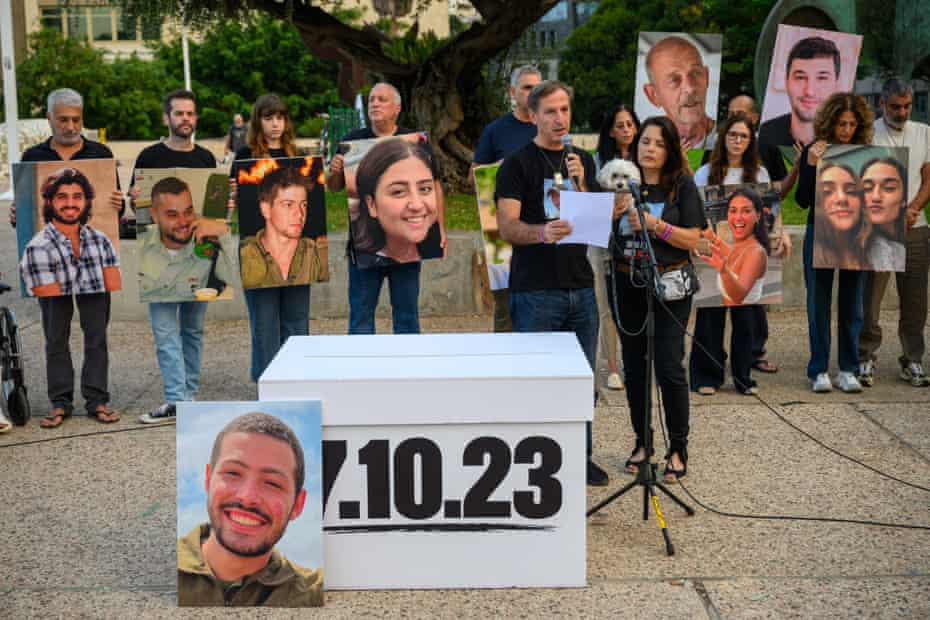
Families of October 7 victims demand accountability
The Israel election has also prompted renewed calls from bereaved families for an independent investigation into the October 7 attacks.
Relatives of victims gathered in Tel Aviv’s Hostages Square at 6.29am on election day, marking the time Hamas launched its assault just over three years earlier.
Holding photographs of their loved ones, the families observed a minute of silence before urging voters to remember the victims when casting their ballots.
In a statement, the group said: “Three years after the massacre, our loved ones will not be voting today. Go out and vote – remember them at the ballot box. This is what these elections are about!”
The families are not explicitly endorsing a particular political party. Their principal demand is the establishment of a state commission of inquiry into the attacks.
Such an investigation could examine the decisions, intelligence assessments and security arrangements that preceded the assault, as well as the government’s response.
Netanyahu has resisted the demand for an independent inquiry, making the issue an important point of disagreement between his government and opposition parties.
For families who lost relatives or endured the hostage crisis, the election represents an opportunity to demand accountability from political leaders.
Their protests also demonstrate that the vote is about more than party competition. It is a judgment on the government’s responsibilities and the lessons Israel should draw from one of the darkest episodes in its modern history.
Voters returning from abroad to influence the outcome
The Israel election has attracted thousands of Israelis living overseas who have returned home to participate in the vote.
Aid Coalition, a US-based nonprofit focused on strengthening Israeli democracy, estimated that as many as 67,000 voters could return to Israel for the election.
Approximately half were expected to travel from the United States, with others arriving from Europe, Canada, Australia and New Zealand.
Israeli citizens generally must vote in person inside the country, with limited exceptions for diplomats and certain official representatives stationed abroad.
The precise political effect of the returning voters remains uncertain. However, some Israelis who have left the country in recent years oppose Netanyahu’s government, raising the possibility that their participation could benefit opposition parties.
Yael Natra, one of the Israelis planning to vote, said she had previously felt it was inappropriate to cast a ballot in a country where she no longer lived.
This year, however, she intended to vote for parties opposed to the existing government.
“The Israel that I grew up in is disappearing,” she said, adding that she feared the consequences if the election failed to produce change.
Another returning voter, Hadar Susskind, said he wanted a new government to reverse course in Gaza and the West Bank.
He and four relatives living in the United States were travelling back to participate in the election and reaffirm their commitment to Israeli democracy.
His intervention reflected the concerns of voters who believe the country needs a different political direction after years of conflict and controversy.
Israel faces uncertain coalition negotiations
The Israel election may produce a complicated parliamentary situation if neither Netanyahu’s coalition nor the opposition secures the 61 seats required to form a government.
Israel’s parliament has 120 seats, meaning a governing coalition must command at least 61 members to hold a majority.
Current polling suggests Netanyahu’s bloc could lose its majority while the opposition also falls short of the required number.
That outcome could force political parties to negotiate with smaller groups, potentially giving them considerable influence over the composition and policies of the next administration.
President Isaac Herzog will have an important constitutional role after the results are finalised. He is expected to consult party leaders and invite the candidate he believes has the best chance of forming a government to attempt to build a coalition.
The nominated candidate can have up to 42 days to form a government.
Consequently, the election result alone may not immediately determine who becomes prime minister. Coalition negotiations could continue after the votes are counted, leaving the country facing a period of political uncertainty.
Whatever the outcome, the election is likely to shape debates about national security, the Gaza war, settlement expansion, democratic institutions and Israel’s international standing.
For Netanyahu, it is a decisive test of whether voters believe he should continue leading the country after years of conflict and political controversy.
For Eisenkot and other opposition leaders, the challenge is to turn dissatisfaction with the government into a parliamentary majority capable of governing.
The results will also reveal whether the far right can expand its influence despite mounting criticism of its policies.
About The Author