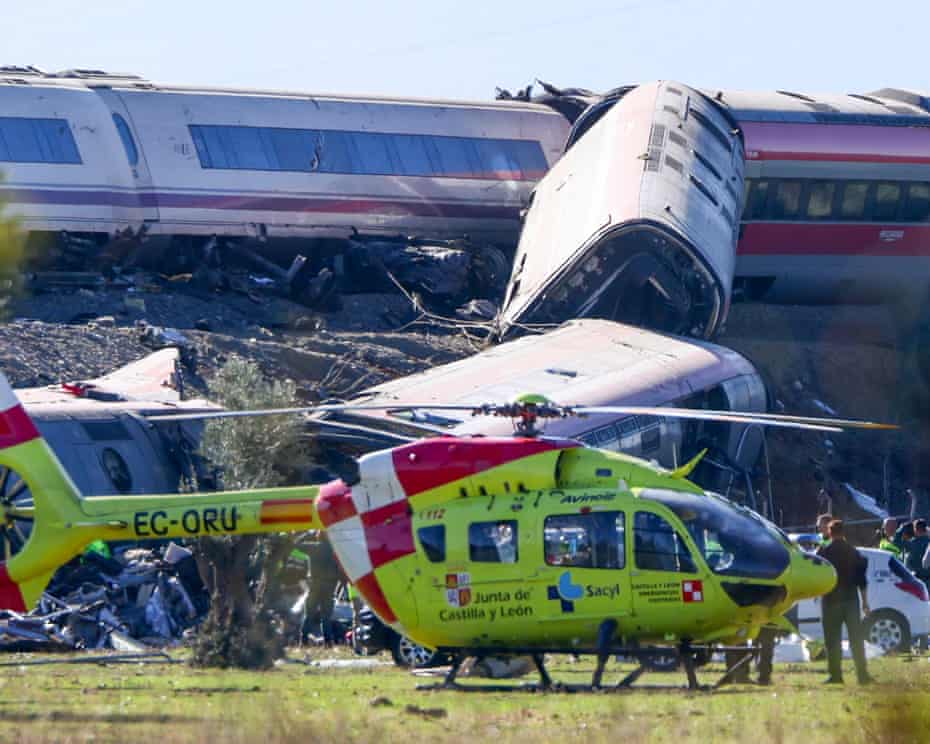
The Spain train crash has claimed at least 31 lives and left 80 people injured after two high-speed trains collided in Toledo province, with authorities warning that the death toll could rise as emergency teams continue searching the wreckage for victims.
The collision occurred on Wednesday, October 28, near Urda station in central Spain, involving an Iryo high-speed service and an AVE train. The disaster has prompted a major emergency response and raised urgent questions about railway safety on one of Europe’s largest high-speed rail networks.
Local authorities initially reported 30 fatalities before revising the death toll to 31, according to information released by the regional government of Castilla-La Mancha. Rescue workers were still attempting to reach the most severely affected sections of the wreckage.
Approximately 80 people were reported injured, including 30 with minor injuries and 50 whose injuries were described as moderate or more serious. Officials fear the figures could increase as rescue operations progress.
Spain Train Crash: What Happened Near Toledo?
The collision involved two high-speed passenger trains carrying a combined total of approximately 544 people, according to preliminary information reported by The Guardian.
The Iryo service, identified as train 7076, was carrying 146 passengers and one baby. The AVE service, identified as train 2080, had 397 passengers on board.
Initial reports indicated that the AVE train travelling behind the Iryo service crashed into it after the first train may have stopped on the line.
The circumstances surrounding the collision remain under investigation. Spanish media reports have raised the possibility of a signalling failure, but authorities have not established a definitive cause.
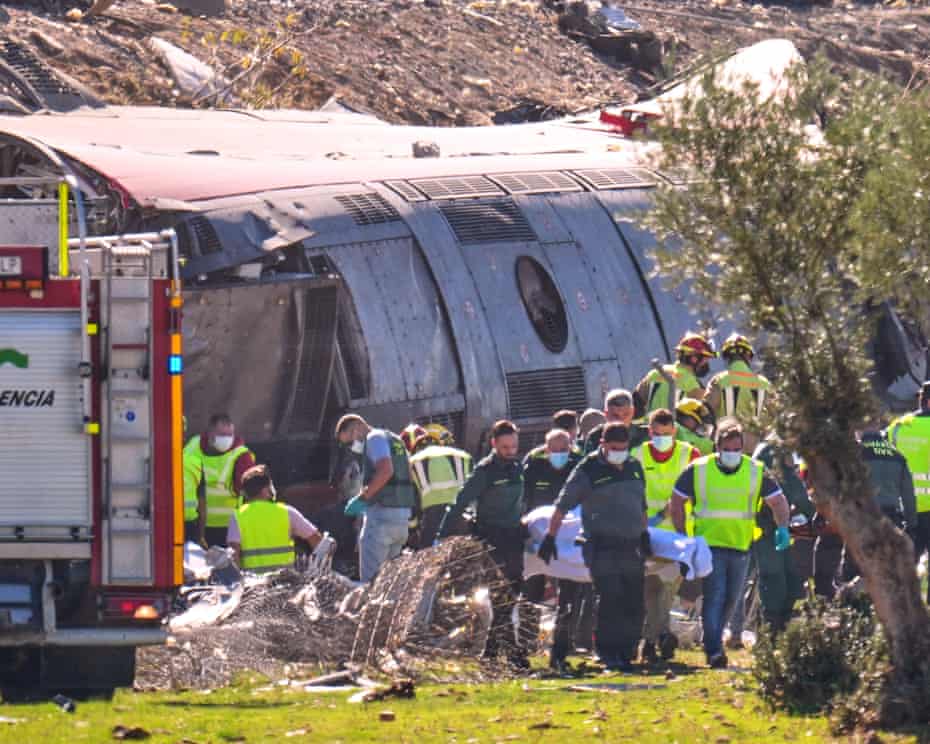
Emergency personnel were dispatched to the scene, where images showed overturned carriages, damaged train cars and rescue workers searching for survivors.
The president of Castilla-La Mancha, Emiliano García-Page, confirmed the initial death toll of 30 and warned that it was likely to rise because rescuers had yet to reach some of the most severely affected parts of the wreckage.
The subsequent increase to 31 deaths underscores the seriousness of the disaster and the difficulties confronting emergency services as they work through the damaged trains.
Possible Signalling Failure Comes Under Investigation
Railway signalling is expected to become a central focus of the investigation into the Spain train crash, particularly because the high-speed line is equipped with technology designed to prevent trains from colliding.
According to transport correspondent Gwyn Topham of The Guardian, the LZB signalling system used on the high-speed route between Madrid and Seville should automatically stop a train when the line ahead is occupied.
The system, whose name translates as “linear train control”, uses continuous electronic communication between railway infrastructure and trains to help control speed and prevent dangerous situations.
Under normal operating conditions, the technology should reduce the risk of a rear-end collision by warning drivers and automatically intervening when necessary.
However, preliminary reports from Spanish newspaper El Mundo suggested that the Iryo train may have experienced a failure in its LZB signalling system shortly before the crash.
The report indicated that the first train may have stopped after detecting the problem, while the AVE train behind it allegedly did not receive the relevant information.
A potential human error was also mentioned in the preliminary account. These details remain unconfirmed, and investigators will need to establish whether a technical malfunction, communication failure or another factor contributed to the collision.
The investigation is particularly important because the signalling technology is designed to prevent precisely this type of accident.
Authorities will need to examine the trains’ operating records, signalling data and communications to determine what happened before the impact.
Spain Faces Renewed Questions Over Railway Safety
The disaster has renewed concerns about railway safety in Spain, which operates Europe’s largest high-speed railway network and the world’s second-largest after China.
The network carried approximately 25 million passengers in 2024, highlighting the importance of maintaining reliable safety systems across the country’s extensive rail infrastructure.
The latest collision is also particularly troubling because it occurred less than a year after another devastating railway disaster in Adamuz, Córdoba province.
That January accident killed 46 people and injured 152 after two trains collided. Investigators identified faulty rails in connection with the Adamuz crash, according to the information cited in The Guardian’s reporting.
The circumstances of the Toledo collision appear different, with early reports focusing on a possible signalling problem rather than the rail defects associated with the earlier disaster.
Spain also experienced a major high-speed railway accident in Galicia in 2013, when 80 people died and more than 140 were injured after a train derailed near Santiago de Compostela.
In that case, the driver was able to ignore speed warnings while approaching a bend, raising questions about the safety systems available to prevent excessive speed.
Another serious railway accident occurred in El Cuervo, Seville, in 1972, when a head-on collision between two passenger trains killed 86 people and injured 112.
The latest disaster is therefore among Spain’s most serious railway accidents recorded since the 1970s, according to the historical comparisons published by The Guardian.
Spain’s High-Speed Rail Technology Faces Scrutiny
The LZB system’s role in the latest collision is likely to attract particular attention because of its intended function in preventing train accidents.
Unlike railway systems that rely primarily on drivers responding to signals, the technology is designed to provide continuous communication between the train and the track, allowing automated intervention when necessary.
This should help prevent a train from continuing into an occupied section of railway, even if the driver fails to apply the brakes.
Spain is also transitioning its high-speed railway signalling systems towards the European Rail Traffic Management System, known as ERTMS, which aims to establish a common standard across European rail networks.
Investigators will need to determine which systems were operating at the time of the crash and whether any technical or operational issues affected communication between the two trains.
They will also need to establish whether the first train’s reported signalling problem was accurately detected and transmitted, and why the train behind may not have responded appropriately.
At this stage, it would be premature to conclude that the signalling system caused the collision. The early accounts provide possible explanations, not a final determination of responsibility.
Spanish Government Responds to the Tragedy
Spain’s political leadership has expressed shock and concern following the collision, as emergency teams continue working to assist victims and establish what happened.
Prime Minister Pedro Sánchez said he was shocked by the accident, while Transport Minister Óscar Puente was working from the emergency control centre to obtain information about the incident.
Puente was expected to provide further information as the authorities assessed the scale of the disaster and the circumstances surrounding the collision.
The Spanish royal family also expressed its condolences. King Felipe VI, speaking during a visit to Bétera, where he was attending military exercises, described the incident as horrific.
He said: “My primary concern is to express my sorrow over this terrible tragedy and to convey our condolences, sadness, support, and affection to the families during such an incredibly difficult and painful time.”
The king also thanked emergency personnel involved in the rescue operation.
The European Commission offered assistance to Spain as investigators began examining the collision.
Commission spokesperson Paula Pinho said the European Union was following developments closely and was ready to support the Spanish authorities.
She said: “Our thoughts and our feelings are with the victims, their families and friends, and all those affected, and the Commission, together with the European Union Agency for Railways, is closely following the situation, and we stand ready to support the Spanish authorities in any way that may be needed.”
However, she cautioned that it was too early to draw conclusions while emergency operations were continuing.
Spanish Football Matches Postponed Following Fatal Collision
The tragedy has also affected Spain’s football calendar, with the Royal Spanish Football Federation announcing the postponement of all Copa del Rey matches scheduled for Wednesday.
The decision was taken as a mark of respect for the victims and their families following the devastating accident in Urda.
In a statement, the federation said: “The great Spanish football family remains united in grief over this tragedy, offering its support to the authorities to help the victims of this devastating accident.”
The federation said a revised schedule for the affected matches would be announced later.
The postponements reflect the scale of the national response to the disaster, which has affected communities, emergency services and public institutions.
Meanwhile, political activities continued in some quarters despite calls for restraint. Vox leader Santiago Abascal continued his campaigning ahead of the following month’s parliamentary election and rejected calls to suspend political activity.
Abascal criticised Sánchez over infrastructure safety, arguing that the government had a responsibility to protect the public. He also claimed that suspending campaigning would risk using the tragedy to silence criticism of the country’s infrastructure.
His comments added a political dimension to the unfolding disaster, although the technical cause of the crash remains undetermined.
Former Labour Minister Reportedly Among Those on Board
Concerns have also emerged over the whereabouts of Spain’s former labour minister Fátima Báñez, who was reportedly travelling on one of the trains involved in the collision.
Antonio Sanz, the Andalusian government’s emergency minister, told Spanish broadcaster RTVE that Báñez was believed to have been on board and had not yet been contacted following the incident.
The report did not confirm her condition, and her whereabouts remained uncertain at the time of the update.
Authorities continued efforts to identify those affected and contact relatives as rescue teams worked through the damaged trains.
The process can be complicated by the scale of the destruction, the number of passengers involved and the injuries sustained by survivors.
Death Toll Could Rise as Rescue Operations Continue
The immediate priority remains locating survivors, treating injured passengers and recovering victims from the wreckage.
With at least 31 people confirmed dead and 80 injured, the collision has already become one of Spain’s deadliest railway disasters in recent decades.
The possibility that more victims remain in inaccessible sections of the wreckage means the final casualty figures may change.
Investigators will also face the complex task of reconstructing the sequence of events, examining the trains’ technical systems and determining whether any safety procedures failed.
Although early reports have pointed towards a possible signalling problem, the authorities have cautioned against drawing conclusions before the investigation is complete.
The disaster has raised difficult questions about the reliability of railway safety systems and the effectiveness of safeguards designed to prevent collisions on high-speed routes.
As Spain mourns the victims, the investigation is expected to play a crucial role in establishing the cause of the tragedy and determining what measures may be necessary to prevent another deadly accident.
About The Author