The Israel election results have left Prime Minister Benjamin Netanyahu and opposition leader Gadi Eisenkot facing an uncertain battle to form the next government, as exit polls suggest their rival blocs are tied while Palestinian parties make significant gains in the Knesset.
With more than half of the votes counted, early projections indicated that Netanyahu’s bloc could emerge ahead, potentially securing 55 seats, while Eisenkot’s opposition grouping was projected to win 49. Palestinian parties were projected to secure 16 seats, although the figures remained subject to revision as counting continued.
The Israeli parliament, known as the Knesset, has 120 seats, meaning a political bloc needs at least 61 to command a majority. Neither side had reached that threshold, raising the prospect of difficult coalition negotiations that could take several weeks.
The election has also recorded exceptionally high participation, with more than 77 per cent of eligible voters casting their ballots. According to Israel’s Central Elections Committee, turnout was approximately seven percentage points higher than in the 2022 election, highlighting the significance of the contest.
Netanyahu and Eisenkot face a political deadlock
Exit polls released by Israel’s major television networks initially placed Netanyahu’s governing bloc and Eisenkot’s opposition grouping on approximately 51 seats each. Earlier forecasts had given Eisenkot’s side a slight advantage, but subsequent projections narrowed the gap.
The changing estimates have made it difficult to determine which political camp will ultimately secure the strongest position in the next parliament. Israeli exit polls can be inaccurate, and final seat allocations may change as additional ballots are counted.
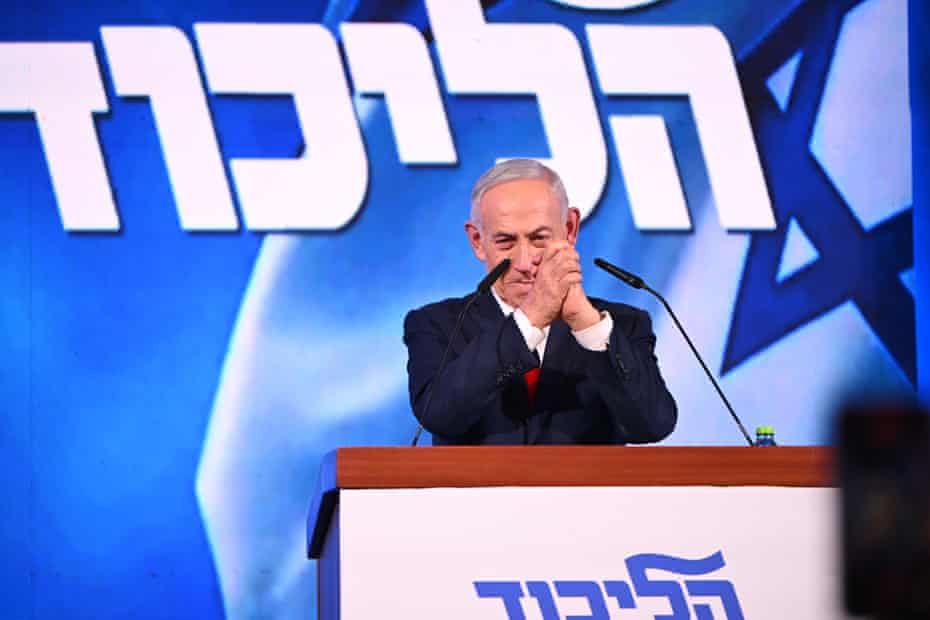
Netanyahu, whose Likud party leads the governing camp, addressed supporters at an election-night gathering in Jerusalem shortly after 3am. Although he did not directly declare victory, he insisted that his party would emerge as Israel’s largest political force.
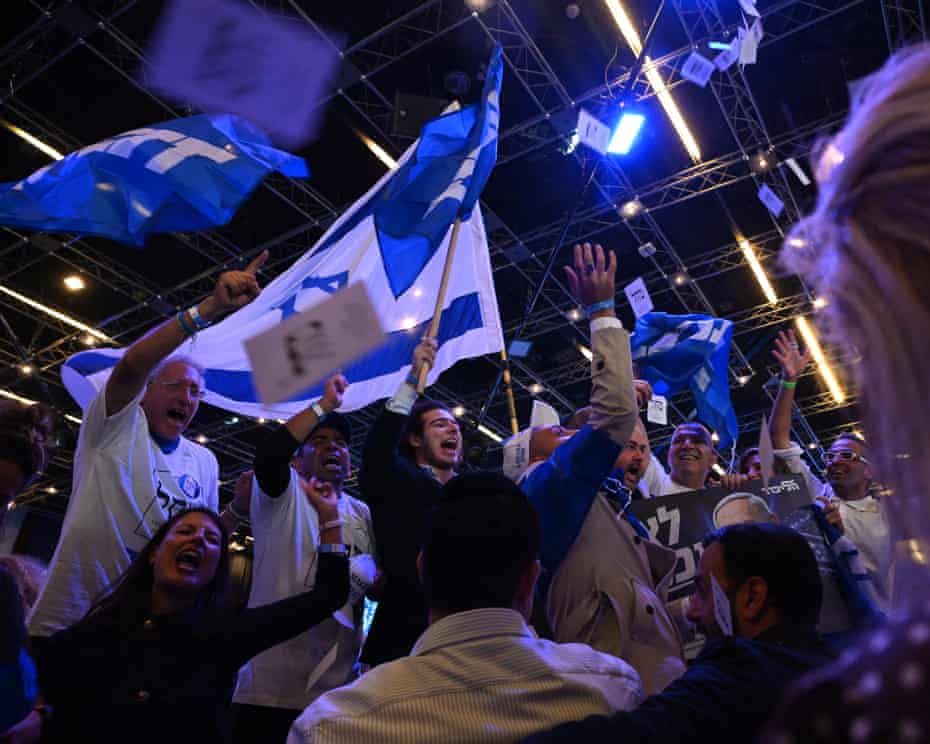
“Likud is the largest party in Israel,” Netanyahu told supporters, according to the reported account of his speech.
He also called for a right-wing government, declaring that Israel must “establish a strong, right-wing national government”. He rejected the possibility of forming an administration that depends on support from Palestinian political parties.
Netanyahu’s position could complicate negotiations if his bloc fails to secure enough seats through its existing partners. With no obvious source of additional support, his prospects may depend on political defections, agreements with other parties or a change in the positions of potential coalition partners.
Eisenkot says voters have rejected Netanyahu
Eisenkot, a former Israeli military chief who leads the opposition grouping, presented the results as evidence that the public wants political change.
Addressing cheering supporters in Tel Aviv, he argued that Netanyahu should accept the message from voters and leave office.
“The Israeli public has voted against Netanyahu’s service as Israel’s prime minister … a worthy leader would have accepted the people’s non-confidence and announced today his retirement from politics,” Eisenkot said.
He also warned the prime minister against using national security concerns to advance his political interests during the uncertain period following the election.
“Netanyahu, don’t you dare use Israel’s security for your political needs,” Eisenkot said in a separate warning.
His remarks reflected concerns among opposition supporters that the continuing uncertainty could create opportunities for Netanyahu to pursue security policies that might reshape the political debate.
Netanyahu has previously raised the possibility of further military action against Iran. During his election-night address, he said Israel had a unique opportunity with US President Donald Trump to eliminate what he described as the existential threat posed by Iran.
Eisenkot’s warning underscored the sensitivity surrounding Israel’s security policy as the parties prepare for negotiations over the next government.
Palestinian parties make significant gains
One of the most consequential developments in the Israel election results is the projected increase in parliamentary representation for Palestinian parties.
Exit polls suggested that Palestinian political groupings could win between 17 and 18 seats, compared with the 10 seats they held previously. Some projections based on the partial count placed their combined representation at a slightly lower figure.
The increase could give Palestinian parties a stronger position in negotiations, particularly if neither Netanyahu nor Eisenkot can assemble a majority through existing political alliances.
Palestinian citizens of Israel account for approximately 20 per cent of the country’s population. Their participation in the election has become increasingly significant as parties representing them seek greater influence over national decision-making.
The Joint List and Ra’am are among the Palestinian political groupings whose support could become important in determining the next government.
Ra’am, led by Mansour Abbas, has previously participated in a governing coalition under former prime minister Naftali Bennett. Its experience in coalition politics could make it a potential negotiating partner for Eisenkot’s bloc.
Abbas said during the campaign that his priority was to remove Netanyahu, Finance Minister Bezalel Smotrich and far-right National Security Minister Itamar Ben-Gvir from power.
However, cooperation would not necessarily be straightforward. Eisenkot has previously argued that Arab-led parties do not meet the Zionist criteria he considers necessary for participation in government.
The Joint List could present an even greater challenge. Its representatives are expected to demand substantial concessions before offering support to an administration led by Eisenkot.
Coalition negotiations could take weeks
Israel’s political system frequently requires parties to negotiate coalitions because no single party has historically secured the 61 seats needed to govern independently.
Following the election, President Isaac Herzog is expected to designate the candidate considered most likely to form a government. That person does not automatically have to be the leader of the party with the largest number of seats.
The designated candidate normally has 28 days to assemble a coalition, with a possible two-week extension. If the negotiations fail, another candidate may be given an opportunity, or the country could eventually face another election.
The current arithmetic leaves several possible scenarios.
Eisenkot could attempt to build a majority by negotiating with Palestinian parties, including Ra’am and the Joint List. Such an arrangement would require agreement among his existing partners and could expose divisions within the opposition camp.
Another possibility would be a minority government that relies on informal support from lawmakers outside the governing coalition. Under that arrangement, Palestinian parties could help an administration survive parliamentary votes without formally joining the government.
The Joint List has previously indicated that it could offer a political safety net to an administration seeking to remove Netanyahu from power, even if it did not join a coalition outright.
Netanyahu, meanwhile, has ruled out relying on Palestinian parties and continues to advocate a government dominated by right-wing and religious factions.
National unity government remains a possibility
A national unity government involving Netanyahu and Eisenkot has also been discussed as a potential solution to the deadlock, although political obstacles remain considerable.
Such an arrangement could require Netanyahu to abandon some of his far-right partners and cooperate with Eisenkot’s centrist opposition grouping. It would represent a major reversal for a campaign built around the opposition’s promise to end Netanyahu’s leadership.
There is a precedent for such cooperation. In 2020, Netanyahu and Benny Gantz reached a power-sharing agreement after an extended period of political instability. However, the partnership collapsed after approximately a year, leading to another election.
A similar arrangement today could face resistance from supporters of both leaders. Eisenkot’s allies have campaigned for a change of government, while Netanyahu’s far-right partners would be reluctant to surrender their influence.
For now, the continuing count and the distribution of seats among smaller parties will determine whether a unity arrangement becomes a serious option.
Ben-Gvir faces disappointment as turnout rises
The election also appears to have delivered a disappointing result for far-right National Security Minister Itamar Ben-Gvir.
Exit polls suggested his Otzma Yehudit, or Jewish Power, party could remain on six seats, matching its performance in the 2022 election instead of achieving the gains some supporters had anticipated.
The reported outcome came despite Ben-Gvir’s efforts to highlight his government’s policies during the campaign. These included legislation approving the death penalty for Palestinians convicted of murdering Israelis and measures that worsened conditions for Palestinian prisoners, according to the report.
Ben-Gvir also criticised members of Netanyahu’s coalition who had floated the possibility of forming a unity government with Eisenkot.
His party’s performance could influence the negotiations if Netanyahu attempts to retain power through an alliance of right-wing and religious parties.
Meanwhile, turnout among Israeli military personnel reached 79.9 per cent, an increase of 6.2 percentage points compared with 2022, according to the Israel Defense Forces.
The military deployed 809 polling stations across bases and combat zones. Special voting arrangements also apply to certain other groups, including diplomats abroad, prisoners, prison guards and hospital patients.
Ballots cast at these special polling stations undergo additional checks before being counted. Their inclusion could affect the final seat projections, particularly given reports that hundreds of thousands of voters used the special arrangements.
Trump comments on Netanyahu’s prospects
US President Donald Trump also commented on the election, saying he had heard that Netanyahu had performed well but cautioning that it was too early to reach a firm conclusion.
“I actually heard he did pretty well,” Trump told reporters at Joint Base Andrews in Maryland.
Trump had endorsed Netanyahu late in the campaign, while the Israeli prime minister highlighted his close relationship with the White House during his election-night speech.
The US president subsequently shared a statement on social media crediting his endorsement with helping Netanyahu recover politically. The post described the outcome as a possible comeback or victory, despite the absence of a clear result.
However, the available projections remained inconclusive, and the final outcome depended on the completion of the count and subsequent coalition negotiations.
Israel faces an uncertain political future
The Israel election results have created a complicated political situation in which neither major bloc appears certain to secure the parliamentary majority required to govern.
Netanyahu retains a potential route to power through his existing right-wing alliances, but his refusal to rely on Palestinian parties could limit his options if his bloc falls short of 61 seats.
Eisenkot, meanwhile, could benefit from the expanded representation of Palestinian parties, but negotiating their support may require compromises that some of his existing partners would resist.
The record turnout demonstrates the high stakes of the election, while the shifting projections underline the uncertainty surrounding the final outcome.
If neither side can assemble a workable coalition, Israel could face another prolonged period of political negotiations and potentially a new election.
For now, the immediate focus remains on the vote count, the final distribution of Knesset seats and the willingness of rival political groups to negotiate. The outcome will determine not only who leads the next government but also how much influence Palestinian parties and smaller political factions will exercise in Israel’s political future.
About The Author