The FAA air traffic crisis has raised fresh concerns about the reliability of America’s aviation infrastructure after a nationwide ground stop disrupted flights following a communications failure affecting air traffic control centres across the country.
The Federal Aviation Administration (FAA) ordered the ground stop on Friday after an issue affected communications at all Air Route Traffic Control Centers. Transportation Secretary Sean Duffy announced the disruption in a post on X, as authorities moved to prevent further complications across the national aviation network.
Duffy later explained that ageing network switches and routers used by the FAA had become overloaded with data and stopped functioning. The precise cause of the failure was not immediately established, although the incident exposed the vulnerability of systems responsible for coordinating aircraft movements across the United States.
The nationwide restriction was lifted after more than four hours, allowing flights to resume. However, Duffy cautioned that restoring the system to full capacity would take additional time, suggesting that the immediate resumption of operations did not mean every part of the network had returned to normal.
The disruption came at a particularly difficult time for airlines and passengers. According to aviation analytics company Cirium, more than 1.5 million passengers were scheduled to depart from US airports on approximately 11,000 flights after 4pm Eastern Time, shortly after the ground stop began.
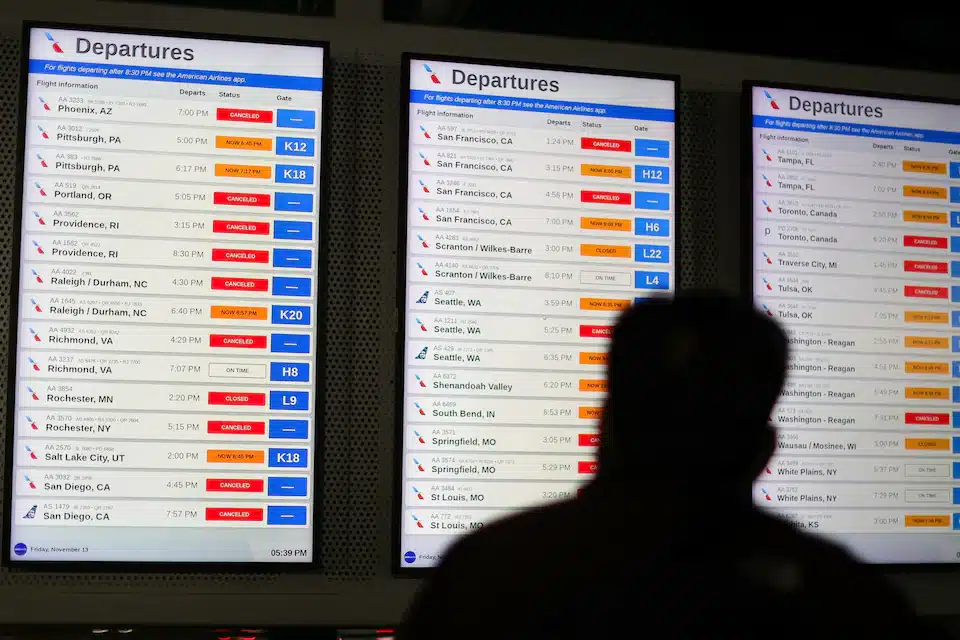
The scale of the scheduled departures illustrated how quickly a technical problem affecting the national air traffic system could create widespread disruption for travellers, airlines and airport operations.
Ageing technology raises questions about aviation safety
Friday’s incident has renewed scrutiny of the technology supporting the country’s air traffic management system. Although the United States operates one of the world’s busiest aviation networks, several essential components of its infrastructure have been identified as outdated and increasingly difficult to maintain.
A 2024 report by the Government Accountability Office (GAO) found that the FAA had classified 51 of its 138 air traffic control systems as unsustainable. Another 54 were considered potentially unsustainable.
Together, the two categories represented more than three-quarters of the systems assessed, highlighting the extent of the technological challenge confronting the agency.
FAA Administrator Bryan Bedford had previously described the fragmented nature of the infrastructure in an interview with Reuters in September. He said more than 300 air traffic facilities operated as technological silos, with some relying on computers and telecommunications equipment that were decades old.
According to Bedford, these facilities often struggled to communicate seamlessly with one another because their systems had developed independently over many years.
The difficulty of maintaining obsolete equipment has also forced the agency to find unusual ways of obtaining replacement components. Some parts have reportedly been purchased through online auctions, while others have been manufactured using 3D printing.
Such arrangements underline the problems associated with keeping ageing infrastructure operational when replacement components are no longer readily available through conventional suppliers.
The FAA air traffic crisis is therefore not simply a question of one technical failure. It has exposed wider concerns about the architecture, maintenance and long-term reliability of the systems used to manage aircraft movements.
Previous telecommunications failure disrupted thousands of flights
The latest breakdown followed another major incident in September, when problems affected a telecommunications circuit serving the Philadelphia air traffic control facility.
The FAA initially encountered error messages on the circuit and its contractor switched operations to a backup fibre-optic line. However, a construction crew subsequently cut through that alternative connection in New Jersey, leaving the facility facing another communications problem.
The September incident resulted in approximately 9,500 delayed or cancelled flights, demonstrating how a failure involving a single telecommunications connection could produce consequences across a much wider aviation network.
Bedford said the existing infrastructure did not provide the level of protection expected from a modern system.
“When it fails, we just don’t have the redundancy that we would get if we had a modern architecture,” he told Reuters.
His comments highlighted a central concern surrounding the FAA’s infrastructure: replacing individual components may not be enough if the broader network remains fragmented and lacks sufficient backup capacity.
Friday’s nationwide ground stop was the first of its kind since January 2023, when a failure in the system responsible for distributing safety notices to pilots forced departures across the country to be suspended.
That earlier incident lasted less than two hours but disrupted more than 10,000 flights, demonstrating that technical problems within the FAA can affect thousands of operations even when the failure does not involve the entire national network.
Government seeks billions for air traffic modernisation
The latest breakdown occurred on the same day the White House and the Transportation Department requested an additional $30.1 billion from Congress for airport and air traffic infrastructure improvements.
The proposed funding includes $10.1 billion specifically for modernising the country’s air traffic control system, reflecting the administration’s recognition that substantial investment is required to address longstanding technological weaknesses.
Congress had already approved $12.5 billion in July 2025 for modernisation projects, including improvements to telecommunications and radar infrastructure.
The administration has said that 68 per cent of the FAA’s legacy copper telecommunications network has been replaced with high-speed fibre-optic connections.
However, Bedford has warned that replacing copper cables with fibre alone will not eliminate the risk of outages. He argued that the agency needs a modern telecommunications network capable of providing reliable connections and sufficient redundancy when individual components fail.
The distinction is important because the September incident demonstrated that even a fibre-optic backup connection can become vulnerable when the wider system is not adequately protected.
Modernisation therefore requires more than installing faster cables. It also involves improving the way different facilities communicate, strengthening backup arrangements and ensuring that failures in one part of the network do not trigger widespread disruption.
GAO warns of planning and coordination problems
Beyond the technology itself, the GAO has raised concerns about the way the FAA is organising its modernisation programme.
In a September report, the government watchdog warned that the agency lacked a reliable cost estimate and an integrated master schedule for the work.
As of May, the FAA had 11,389 separate project schedules that were not properly coordinated with one another.
The absence of a unified schedule could make it difficult for the agency to determine how individual projects depend on one another, monitor overall progress and identify potential delays before they become serious problems.
The GAO warned that poorly coordinated planning could result in duplicated work, delays and cost overruns, potentially undermining the modernisation programme.
The FAA has set December 2028 as its target for completing the first phase of the project. However, the watchdog’s concerns have raised questions about whether the agency can meet its objectives without stronger planning and coordination.
Delays would mean that air traffic controllers and aviation facilities could remain dependent on outdated equipment for longer, prolonging the risks associated with systems that are increasingly difficult to maintain.
The problem is particularly significant because the modernisation programme is intended to address weaknesses that have developed over several decades. Without an integrated approach, the agency could spend billions of dollars replacing equipment while leaving important structural problems unresolved.
Pressure mounts for a more reliable aviation network
Friday’s disruption has added urgency to calls for a comprehensive overhaul of the country’s air traffic control infrastructure.
The United States depends on a complex network of control centres, telecommunications connections, radar systems and computer equipment to coordinate aircraft movements safely and efficiently.
When those systems fail, the consequences can extend beyond the facility where the original problem occurs, affecting flight schedules, airport operations and passengers across multiple regions.
The recent incidents have also demonstrated that backup arrangements are essential. A modern network must be capable of maintaining operations when individual connections or equipment fail, rather than relying on ageing systems that can leave facilities vulnerable to wider disruptions.
With more than three-quarters of the FAA systems assessed by the GAO classified as unsustainable or potentially unsustainable, the scale of the challenge is substantial.
The administration’s funding request, the agency’s modernisation plans and the warnings from government auditors all point to the need for urgent improvements.
However, the success of the programme will depend not only on the amount of money approved but also on how effectively the projects are coordinated and whether the resulting infrastructure can deliver the reliability and resilience required.
For passengers, airlines and air traffic controllers, the central concern is ensuring that another technical breakdown does not bring large parts of the national aviation network to a standstill.
About The Author