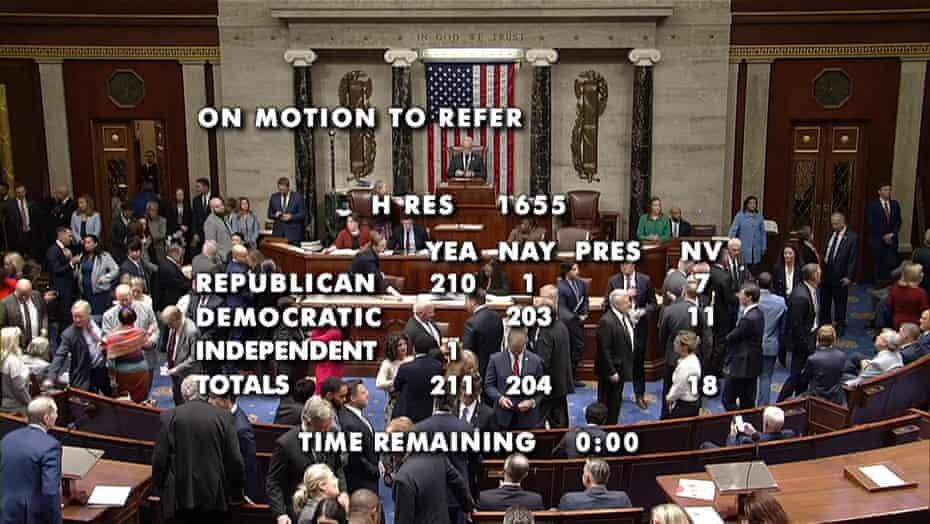
The Hegseth removal battle suffered a major setback on Tuesday after House Republicans blocked an attempt to impeach the US Defence Secretary over allegations of constitutional violations linked to the Iran war and other military operations.
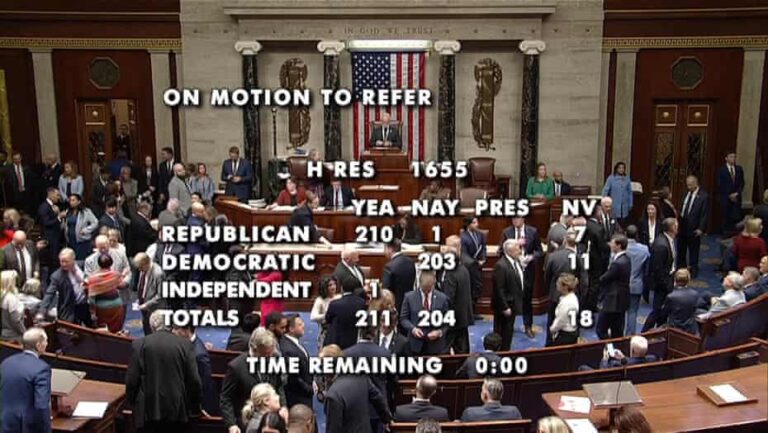
The House of Representatives voted 211-204 to refer eight impeachment articles against Pete Hegseth to the Judiciary Committee, effectively preventing the resolution from advancing at this stage.
Thomas Massie, the Republican congressman who introduced the impeachment resolution, was the only member of his party to oppose the motion. All Democrats also voted against it.
The outcome provided immediate relief for Hegseth, who continues to enjoy the support of President Donald Trump despite mounting criticism of his handling of military operations and the Pentagon.
However, the decision may not end the controversy, particularly as Democrats prepare to take control of the House in January following their decisive victories in the November midterm elections.
Trump celebrates defeat of impeachment resolution
Trump welcomed the congressional decision, describing it as an exoneration of a prominent ally in his administration.
The president, who was impeached twice during his political career, also attacked Massie for introducing the resolution and accused Democrats of abusing congressional procedures.
“The Democrats continue to weaponize and abuse the United States of America,” Trump wrote on Truth Social. “They must be stopped!”
He also celebrated what he described as the “EXONERATION of a Great American Patriot”.
The Pentagon quickly echoed the president’s position, presenting the House decision as a decisive victory for Hegseth and the American military.
Sean Parnell, a spokesperson for the Department of War, said referring the impeachment articles to the Judiciary Committee marked a significant defeat for those seeking the defence secretary’s removal.
“The referral of these baseless impeachment articles to the House judiciary committee marks total victory for Secretary Hegseth, the Department of War, and the American warfighter,” Parnell wrote in a social media post.
Although Republicans prevented the immediate advancement of the resolution, the allegations against Hegseth remain politically contentious.
Democrats threaten to reopen the case
The political situation could change when Democrats assume control of the House in January, particularly because their leadership has already expressed support for holding Hegseth accountable.
House Minority Leader Hakeem Jeffries, who is expected to become the next speaker, has openly endorsed the impeachment initiative.
Speaking to PBS on Tuesday, Jeffries made his position clear, declaring that he was “a hard yes on the Hegseth resolution”.
He accused the defence secretary of abusing his authority, weakening American security and contributing to a costly military conflict that had increased financial pressure on citizens.
“He’s abused his power. He’s undermined our national security. And Pete Hegseth is the architect of this reckless and costly war of choice in Iran, which has made our country less safe and made life more expensive for the American people,” Jeffries said.
His comments suggest that the incoming Democratic majority could make Hegseth’s conduct a significant issue when it takes over the House.
The November elections have consequently changed the political calculations surrounding the defence secretary, even though Republicans retained enough support to block the latest attempt.
Massie’s eight allegations against the defence secretary
Massie introduced the impeachment resolution in September, accusing Hegseth of committing several constitutional violations through his involvement in American military operations.
The Republican congressman’s proposal contained eight articles covering the Iran conflict, civilian casualties, military interventions abroad and the treatment of political critics.
One of the central accusations concerned the decision to launch military operations against Iran without first obtaining congressional authorisation.
Massie also accused Hegseth of disregarding a war powers resolution approved by the House and Senate in June, which sought to compel an end to the conflict.
Another allegation concerned the administration’s handling of civilian casualties, particularly following an American strike on a school in Minab, Iran.
The attack killed more than 168 people, making it one of the deadliest incidents associated with the conflict.
The impeachment articles alleged that Hegseth ignored legal requirements intended to minimise civilian deaths during military operations.
The resolution also questioned the legality of American military activities outside the Middle East, expanding the controversy beyond the Iran war.
Caribbean killings, Venezuela and Yemen operations
Two of the impeachment allegations concerned American military strikes against boats suspected of transporting drugs in the Caribbean Sea and eastern Pacific Ocean.
Massie’s resolution accused Hegseth of involvement in the extrajudicial killings of at least 221 people aboard the vessels.
Another article focused on Democratic Senator Mark Kelly, accusing the defence secretary of suppressing free speech through retaliation against the senator for criticising him.
Read more here: Iran war backlash grows as Hegseth attacks Republican impeachment effort
https://swiftreportnow.com/iran-war-backlash-grows-as-hegseth-attacks-rep/
The final two articles examined Hegseth’s involvement in the American military operation that captured Venezuela’s then president, Nicolás Maduro, and the bombing campaign against Houthi forces in Yemen.
Massie argued that these operations formed part of a wider pattern of constitutional violations under Hegseth’s leadership.
The allegations remain claims contained in the impeachment resolution. Tuesday’s congressional vote did not amount to a judicial determination of their validity.
Iran war exposes divisions within Republican Party
The impeachment controversy comes amid growing disagreements among Republicans over the prolonged military conflict with Iran.
Although most members of the party supported blocking the resolution, some Republicans have previously joined Democrats in challenging the administration’s military strategy.
Before the midterm elections, a small but growing number of Republican lawmakers supported war powers measures intended to compel Trump to bring the hostilities to an end.
However, opposition to the conflict has not necessarily translated into support for removing Hegseth.
Republican congressman Warren Davidson, who supported some of the war powers resolutions, rejected Massie’s impeachment initiative.
He argued that the proceedings were an attempt to make Hegseth personally responsible for decisions involving both the president and Congress.
“It’s an effort to blame-shift on to Hegseth Congress’s failure and President Trump’s decision,” Davidson said.
Davidson nevertheless defended the secretary’s leadership at the Pentagon, praising his efforts to improve military morale and strengthen the armed forces.
“I think Hegseth has been incredibly effective at restoring morale for the active-duty force, restoring the warrior ethos, the proper focus to the military that they exist to fight and win wars.”
The disagreement illustrates the difficult position facing Republicans who have concerns about the Iran conflict but remain unwilling to support an impeachment effort against a senior member of Trump’s administration.
Hegseth’s Pentagon leadership under scrutiny
Hegseth, a former Fox News presenter and Army National Guard officer, has become one of the most outspoken members of Trump’s second-term cabinet.
His approach to running the Pentagon has involved significant changes to the military’s leadership structure and personnel policies.
Several senior generals have departed under his watch, while the promotions of numerous military officers have been blocked.
Some of those affected by the promotion decisions were women and people of colour, generating further criticism of his leadership.
He also introduced new rules governing journalists’ access to the Pentagon, prompting much of the press corps to leave the defence headquarters.
These decisions have reinforced concerns among critics about his management style and the extent of his influence over the military.
Meanwhile, Hegseth has become the public face of several controversial administration policies, particularly the Iran war.
The conflict has continued for months, placing upward pressure on petroleum prices and contributing to the political difficulties Republicans experienced during the midterm elections.
Senate approval would still be necessary
Even if the impeachment resolution had survived the House proceedings, removing Hegseth would have required approval from the Senate.
Republicans currently control the upper chamber with a 53-seat majority, presenting a significant obstacle to any attempt to secure his removal.
It remains uncertain whether enough senators would have supported the resolution or whether Republican leader John Thune would have allowed it to proceed for consideration.
For now, the House decision has prevented the impeachment articles from advancing, giving Hegseth temporary relief from the congressional challenge.
However, Democrats’ expected control of the House from January could reopen the confrontation over his conduct and the administration’s military decisions.
The Guardian reported that although Republicans successfully blocked the immediate impeachment effort, the allegations against Hegseth and the controversy surrounding the Iran war remain unresolved.
About The Author