Serbia’s opposition landscape faces a potential turning point as the Serbia student protest movement prepares to challenge Aleksandar Vučić’s political establishment in a parliamentary election that could end more than a decade of Serbian Progressive Party dominance.
The student-backed coalition, operating under the name Student List, has emerged from two years of demonstrations into an organised electoral force. Its campaign draws support from citizens frustrated by corruption allegations, deteriorating public infrastructure and the lack of accountability following a deadly railway station collapse.
With voting scheduled for Sunday, the movement is attempting to convert widespread street mobilisation into parliamentary representation, despite facing a ruling party with substantial influence over state institutions and national television.
The contest could have consequences beyond Serbia, particularly if a student-led campaign manages to weaken a government closely associated with Hungary’s former leader Viktor Orbán and other nationalist political figures in the region.
From University Demonstrations to a National Political Challenge
What began as student anger over a public infrastructure disaster has developed into one of the most significant challenges Vučić has faced during his years in power.

The movement initially avoided conventional party structures, choosing collective leadership and open discussions instead of placing authority in the hands of a single political figure.
That approach helped protect the protesters from attacks focused on individual leaders while allowing students from different universities to participate in decision-making.
Over time, the demonstrations attracted support from academics, professionals, farmers and ordinary citizens who wanted stronger accountability from public officials.
The movement has now assembled 250 parliamentary candidates, many nominated through university faculties. Its list reportedly includes more than 160 doctorate holders, alongside candidates from other professional backgrounds.
Every candidate was required to obtain approval through the movement’s plenary meetings, reinforcing its claim that the campaign belongs to a wider civic movement rather than an established political elite.
Student List believes this unconventional structure could appeal to voters who have lost confidence in traditional political parties.
Its challenge is to demonstrate that an organisation built around protests and collective decision-making can also operate effectively inside parliament.
Door-to-Door Campaign Seeks to Win Over Ordinary Voters
Instead of depending entirely on television coverage and conventional rallies, student volunteers have taken their campaign directly to communities across Serbia.
In Krnjača, a suburb of Belgrade, volunteers visited housing estates with mobile applications, questionnaires and campaign identification designed to help them monitor their progress.
The campaigners asked residents to identify the most serious problems affecting Serbian society. Their conversations frequently turned to corruption, inadequate infrastructure and frustration with political leadership.
Some residents pledged their support, while others offered to help the movement by transporting voters to polling stations.
One supporter stressed the importance of high turnout, suggesting that participation could be decisive in removing a deeply entrenched government.
Student List hopes to extend the campaign into rural areas, where the ruling Serbian Progressive Party has traditionally enjoyed considerable support.
The movement believes personal contact with voters can help overcome its limited access to national television and reach citizens who rarely participate in opposition politics.
However, the extent to which the students have established a strong presence outside major cities remains disputed.
Gordana Čomić, a former opposition Democratic Party member who later served in an SNS government, argued that the campaign was exaggerating its rural reach.
She predicted the movement might secure approximately 80 seats in the 250-member National Assembly but questioned whether its candidates would know how to operate effectively after entering parliament.
Corruption Allegations Put Government Accountability at the Centre of the Campaign
Corruption has become one of the strongest themes in Student List’s campaign, reflecting longstanding concerns about the relationship between political power, public institutions and organised crime.
The movement’s slogan, “Serbia or Mafia?”, is intended to confront public perceptions that criminal networks have too much influence over the country’s political system.
There have been repeated allegations of links between elements of the ruling party and organised crime. The government rejects such accusations and says it is committed to fighting criminal activity.
Serbia’s poor performance on Transparency International’s corruption index has nevertheless contributed to concerns about the effectiveness of its institutions.
For voters in Krnjača, the issue is not limited to national political controversies. Residents also complain about the failure to resolve practical problems affecting their daily lives.
A poorly maintained bridge connecting the suburb with central Belgrade and a sewage system that repeatedly fails during heavy rain were among the issues raised with student canvassers.
Some residents recalled that Vučić had previously promised improvements during a visit but said the problems remained unresolved.
The contrast between expensive vehicle showrooms and neglected public spaces has also fuelled complaints that economic growth has not translated into better living conditions for everyone.
Although Serbia’s economy has expanded in recent years, many citizens believe the benefits have not been distributed fairly.
For Student List, these grievances offer an opportunity to present the election as a choice between the existing political order and a demand for greater transparency.
Novi Sad Tragedy Continues to Fuel Public Anger
The movement’s origins lie in the collapse of a concrete canopy at Novi Sad railway station on 1 November 2024, which killed 16 people.
The disaster provoked national outrage after evidence pointed towards potentially faulty modifications carried out during refurbishment work.
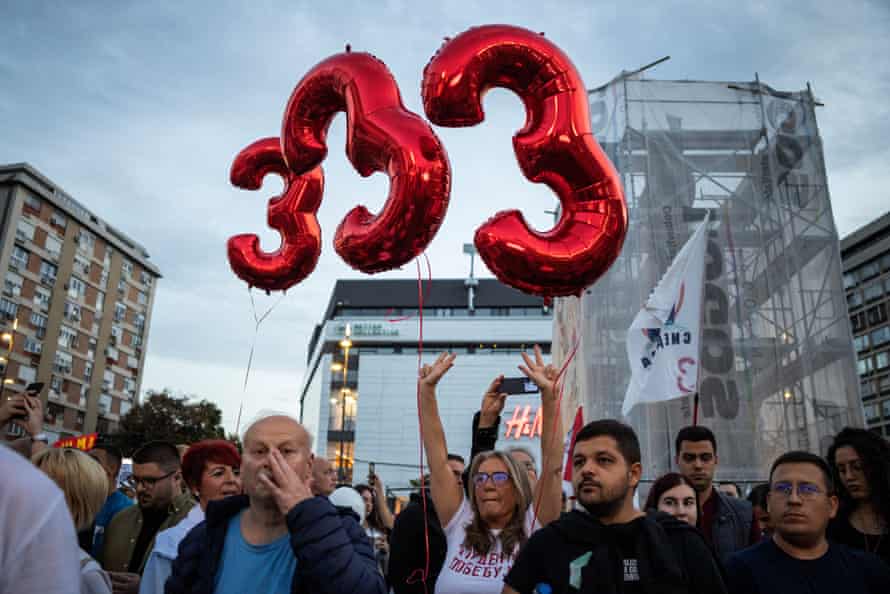
By the time of the election campaign described in the report, no official finding had established the cause of the collapse, and no official had been held accountable.
Students in Belgrade organised a road blockade and vigil three weeks after the tragedy to honour the victims and demand answers.
The protest took a more confrontational turn when demonstrators were attacked by individuals described as members of an SNS-aligned group.
That incident helped spread the movement beyond university campuses, bringing more citizens into demonstrations against the government.
For many protesters, the tragedy became a symbol of what they regard as a broader failure of accountability in Serbia.
Radivoje Grujić, a Serbian electoral consultant based in Warsaw, argued that the disaster had encouraged politically disengaged citizens to reconsider their position.
“These people were saying: I’m not involved in politics, and then politics got them killed,” he said.
He suggested that people who had previously avoided voting could become an important source of support for the students, particularly if they believe the railway station tragedy exposed serious weaknesses in public oversight.
The movement’s challenge is to convert that anger into votes rather than allow it to dissipate after the election.
Vučić Changes Political Strategy Ahead of Parliamentary Vote
Vučić has responded to the challenge by intensifying his campaign and changing his formal position within the political system.
He announced his resignation as president in late September and called an early parliamentary election, a move widely interpreted as an attempt to preserve his influence by returning as prime minister.
His departure came months before the constitutional end of his second and final presidential term.
The Serbian Progressive Party, which has dominated national politics for years, remains the central force behind his political project.
Vučić rose to prominence in the 1990s as a radical nationalist and served as information minister under Slobodan Milošević during the Kosovo conflict.
Although his presidency has not reproduced the militarism associated with Milošević, critics say he continues to use nationalist rhetoric and portray political opponents as instruments of foreign powers.
The student movement has proved difficult to neutralise through the familiar tactics of political division and personal attacks.
Raša Nedeljkov, programme director of the Centre for Research, Transparency and Accountability, said the ruling party was facing a different kind of opponent.
“What we are seeing in the past days, weeks, months, is that strength; the homogeneous government that Vučić used to have is no longer there. He is faced with a completely unorthodox political actor and the toolbox that he has improved over the years since he came to power is no longer effective.”
A July survey conducted by CRTA and Stanford University found support for Student List at 45 per cent, compared with 36 per cent for the SNS.
However, the poll was conducted before Vučić announced his resignation and before the ruling party stepped up its campaign.
More recent domestic polls have placed the SNS ahead, although opposition figures have questioned the independence of some of the organisations conducting them.
Vučić has also increased his television appearances. He made 129 live television appearances in August, more than four times the number recorded in the previous month.
Unequal Media Access Creates a Major Obstacle
Student List is attempting to compete against a party that enjoys extensive access to national television and considerable influence over the state apparatus.
A September survey by CRTA found that 69 per cent of airtime on Serbian television channels was devoted to the ruling majority.
Among the remaining coverage allocated to the opposition, 42 per cent was negative in tone and 53 per cent was neutral.
The figures highlight the difficulty facing a movement that lacks the media resources available to the governing party.
To overcome the imbalance, the students have prioritised direct engagement with voters and sought to establish campaign networks throughout the country.
Their strategy is particularly important in rural communities, where established political loyalties may be harder to change.
Student List has also attempted to limit divisions within its own ranks by leaving controversial policy questions to collective deliberations.
The future of Serbia’s European Union membership, for example, has been left to a referendum, while the movement maintains the country’s claim over Kosovo.
Milica Jovanović, an assistant professor at the University of Belgrade and a candidate on the list, defended the movement’s lack of conventional political experience.
“We are political amateurs, but we are experts,” she said.
She argued that the candidates had managed projects, organisations and communities and believed their willingness to improve public administration could be more important than years spent in established political parties.
Whether voters accept that argument will be a key test of the movement’s appeal.
Election Integrity Fears Raise Prospect of Confrontation
The possibility of a disputed result is another major concern as Serbia approaches voting day.
Previous elections have been accompanied by allegations of voter intimidation, vote-buying and ballot-box stuffing.
Student List has also accused the foreign ministry of manipulating arrangements for diaspora voting by keeping polling stations open in locations where the ruling party is strong while closing them in parts of North America where the opposition expects better results.
The ministry had not responded to a request for comment in the report.
The students are planning to deploy an unusually large number of opposition election monitors to observe proceedings and identify possible irregularities.
However, tensions could rise if monitors challenge the conduct of voting or if competing parties dispute the results.
Momcilo Marjanovic, who said he had worked with groups used to intimidate opposition gatherings, described alleged activities connected to the ruling party in an interview with the Balkan Investigative Reporting Network.
“My role was to lead a group of guys to the riskiest and most critical places, to any gatherings where students or the opposition were on the other side,” he said.
Marjanovic alleged that he had been paid covertly through a fictitious job at a public utility and described the use of force against political opponents.
“It was our job, as a last resort of course, to use force, although it often happened not as a last resort.”
His account adds to concerns about intimidation during the campaign, although the allegations do not independently establish responsibility for every reported incident.
Diplomats in Belgrade believe preparations for Serbia to host the international EXPO 2027 event could discourage widespread violence because unrest could damage the country’s international reputation.
Nevertheless, a close result could lead to disputes, repeated recounts and street demonstrations.
Minority Parties Could Influence the Next Government
Even if the ruling party or Student List emerges as the largest political force, the final balance of power may depend on smaller parties.
Political organisations representing ethnic Hungarians, Bosniaks and Albanians could become important partners if neither major bloc secures sufficient parliamentary support.
For Student List, winning a substantial number of seats could provide an opportunity to challenge the government, demand institutional changes and push for greater accountability.
However, translating protest demands into legislative action would require negotiations and a clear strategy for working within parliament.
Čomić has questioned whether the students would be willing or able to cooperate with established political groups, warning that internal disagreements could undermine their influence.
The movement’s supporters, meanwhile, see its independence from conventional party structures as a strength rather than a weakness.
The result will help determine whether voters view the students as a credible alternative government or primarily as a protest organisation.
Students Prepare to Defend Their Electoral Gains
Student List has spent recent weeks preparing for the possibility that the election result could be contested.
Its organisers are determined to prevent a disputed outcome from ending the movement’s momentum and have discussed how supporters might respond if they believe the vote has been manipulated.
Jelena Kleut, an associate professor of media studies, said many protesters viewed the election as a decisive moment.
“I think there is a strong feeling of now or never,” she said.
Read also: Milan protests: Italy to deploy 500 soldiers as looting forces luxury shops to close
https://swiftreportnow.com/milan-protests-italy-to-deploy-500-soldiers/
She added that citizens had experienced what the government was capable of and understood that continued public pressure might be necessary.
“I think that people have really felt in their skin what the regime is capable of and there is a sense you still need to stay strong because the job is not finished.”
The election therefore represents more than a contest for parliamentary seats. It is a test of whether a protest movement can transform public anger into a sustainable democratic challenge.
A strong result could weaken Vučić’s political dominance and encourage further demands for transparency, accountability and institutional reform. A disappointing performance, however, could expose the difficulties of challenging an established political machine without conventional party structures.
Whatever the outcome, two years of student-led mobilisation have already reshaped Serbia’s political debate. Sunday’s vote will determine whether that energy can deliver a major electoral breakthrough.