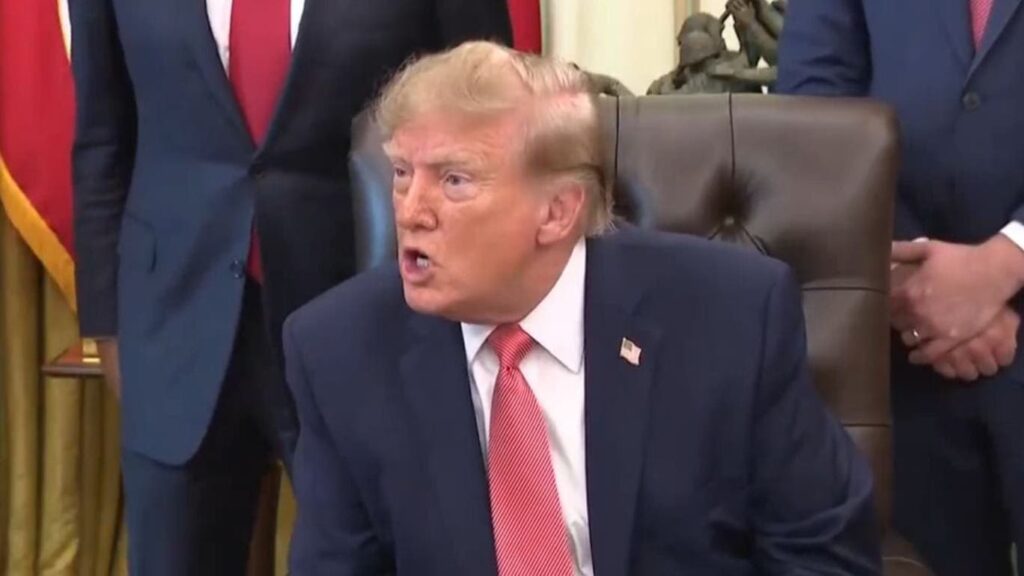
US President Donald Trump clashed with The Independent reporter Andrew Feinberg in the Oval Office after being questioned about a new fraud-reporting programme offering whistleblowers rewards of up to $30,000. The exchange escalated as Trump challenged the journalist, while Vice President JD Vance and administration officials also criticised him.
The confrontation began during an announcement involving Trump and Vance about a proposed hotline for reporting alleged fraud. Instead of focusing entirely on the programme, the event became a heated exchange over existing federal whistleblower protections, with Trump eventually telling Feinberg to be quiet.
Feinberg later described the incident in an account published by The Independent, saying he had been carrying out his regular duties as a White House reporter when the president turned his attention towards him.
Trump Clashes With Reporter Over Fraud Reward Programme
Feinberg attended the Oval Office event as part of the White House press pool, a rotating group of journalists assigned to cover presidential appearances and report back to other news organisations.
On this occasion, his role was primarily to ask questions rather than produce the usual short account of the event.
The announcement concerned a proposed programme through which people reporting fraud could receive financial rewards of up to $30,000. The administration presented the initiative as a way to encourage whistleblowers to expose suspected misuse of government funds.
The programme was connected to the administration’s campaign against alleged fraud involving day-care centres and home healthcare businesses in Minnesota run or owned by Somali-Americans.
Right-wing YouTuber Nick Shirley had attracted attention through videos alleging widespread fraud in the sector. The administration subsequently highlighted his work and planned to reward him during the event.
However, Feinberg questioned whether the proposed programme was necessary when federal law already provides a mechanism for whistleblowers to receive substantial financial rewards.
Having covered the federal government for years, the journalist pointed to the False Claims Act, which allows individuals to bring certain lawsuits on behalf of the government to recover money lost through fraud.
The law dates to 1863, during President Abraham Lincoln’s administration, although amendments in 1986 strengthened its whistleblower provisions.
Feinberg argued that the existing system can provide significantly larger rewards than the one per cent figure Trump cited when discussing the administration’s proposal.
Reporter Challenges Trump Over Existing Whistleblower Law
The exchange intensified when Feinberg asked Trump why potential whistleblowers would use the administration’s proposed hotline instead of pursuing the existing legal process.
According to Feinberg’s account, Trump responded: “Because it’s a lot of money.”
Trump then defended the proposed reward structure, arguing that even a relatively small percentage of recovered funds could generate substantial payments when the amounts involved were large.
“At 1 percent, people will make millions and millions of dollars for turning in what actually is a somewhat routine crime of, you know, of millions of millions. But we’re talking about we’re talking about billions and actually probably trillions of dollars,” Trump said.
The president’s response did not directly address Feinberg’s comparison between the proposed programme and the False Claims Act’s existing financial incentives.
Under the False Claims Act, eligible whistleblowers may receive a share of the money recovered by the government through successful cases. The amount depends on the circumstances and applicable legal requirements, and can reach a substantial proportion of the recovery.
The distinction became central to the confrontation because Feinberg was questioning whether the administration’s proposal offered a meaningful advantage over the established legal framework.
The exchange also highlighted a broader issue surrounding government anti-fraud initiatives: how new reporting programmes relate to existing legal protections and incentives for people who expose suspected wrongdoing.
JD Vance Joins the Exchange
Vice President JD Vance intervened after Trump responded to the journalist’s question.
Vance described Feinberg’s question as “dishonest” and argued that certain types of fraud might fall outside the False Claims Act’s scope.
Feinberg disputed that characterisation, maintaining that the law already covers relevant categories of fraud involving government programmes.
The disagreement changed the tone of the event, moving the discussion away from the planned announcement and towards a direct dispute between the administration and the reporter.
Feinberg suggested that Vance’s intervention influenced Trump’s subsequent response to him.
According to the journalist, the president asked who he was, despite having encountered him on previous occasions in the Oval Office and elsewhere during the past decade.
Feinberg said Trump had appeared to recognise him earlier in the event, making the later question particularly striking.
He identified himself as Andrew Feinberg of The Independent.
The vice president’s participation also recalled an earlier disagreement between Vance and Feinberg during a White House briefing, when the journalist questioned him about Trump’s stock trading.
The latest exchange therefore unfolded against the background of previous confrontations between the reporter and senior administration figures.
Trump Calls Journalist a “Sick Person”
The disagreement continued as journalists attempted to ask additional questions during the Oval Office gathering.
Feinberg said he had prepared questions on several subjects, including Trump’s plans to renovate a popular golf course in Washington, DC.
However, he described repeatedly finding himself at the centre of the president’s attention.
On some occasions, Trump appeared to point towards Feinberg but seemed to be trying to select an Agence France-Presse reporter standing directly behind him.
From his position, Feinberg said, the gestures appeared to be directed at him, prompting him to begin asking questions.
Trump objected to the interruptions and challenged the reporter.
“I don’t know who the hell you are, but you better be careful,” the president said, according to Feinberg’s account.
The journalist noted that he had already identified himself less than 10 minutes earlier.
When a similar misunderstanding occurred again, Trump became more confrontational.
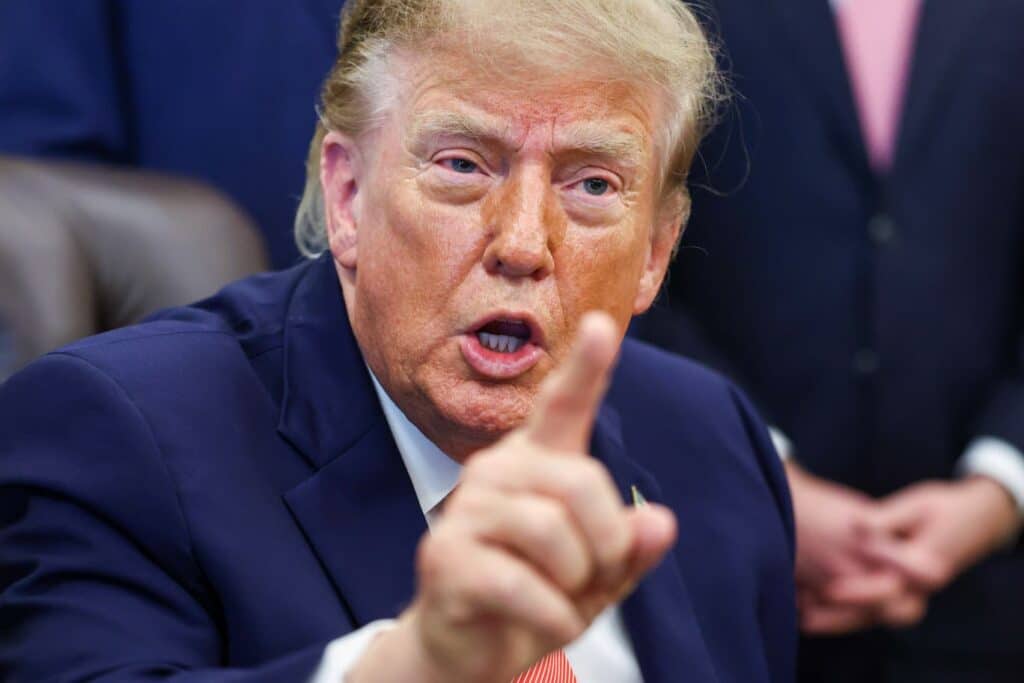
“I actually think there’s something wrong with you,” he said, also describing Feinberg as a “sick person.”
The president ultimately told the reporter to be quiet as the press gathering came to an end.
Feinberg presented the encounter as an example of how a routine question about government policy developed into a personal exchange involving the president and his administration.
White House Response Targets the Independent Reporter
The confrontation continued beyond the Oval Office, with members of the administration directing criticism at Feinberg.
The journalist said the White House rapid-response operation referred to him as a “Mongoloid Moron”, a derogatory slur historically used against people with intellectual or developmental disabilities.
Feinberg condemned the language and emphasised that it was not a phrase he would use.
Vance also criticised the journalist through his official government account, labelling him an “imbecile”.
The remarks extended the dispute from the substance of the fraud announcement to personal attacks against the reporter who had questioned the administration.
The episode also drew attention to the relationship between political leaders and journalists who challenge their claims during public appearances.
Press briefings and presidential events provide reporters with opportunities to scrutinise official announcements, question the evidence behind policy claims and ask why the government is pursuing a particular approach.
The exchange illustrated how those interactions can become contentious when officials dispute a journalist’s premise or object to the line of questioning.
Feinberg maintained that he had been doing his job by asking about an existing law that appeared relevant to the programme being announced.
What the False Claims Act Provides
The legal issue at the centre of the dispute concerns the federal government’s longstanding system for recovering money obtained through fraudulent claims.
The False Claims Act was enacted in 1863 during the American Civil War, when the government sought to address fraud involving military supplies and contracts.
Its modern provisions allow private individuals, known as relators, to bring certain cases on behalf of the government. These lawsuits are commonly referred to as qui tam actions.
If a case results in a recovery, the whistleblower may qualify for a share of the proceeds, subject to statutory rules and the circumstances of the case.
The law can apply to fraud involving federal healthcare programmes, government contracts and other claims for public money.
That framework was central to Feinberg’s question because the administration’s proposed hotline was presented as a new way to encourage people to report fraud.
The journalist’s argument was that the existing law already provides financial incentives, sometimes considerably greater than the percentage Trump mentioned.
However, the existence of the False Claims Act does not necessarily mean every suspected fraud case qualifies for a qui tam lawsuit. Eligibility depends on the facts, the applicable law and the nature of the claim.
The administration’s proposal and the existing legal process may therefore operate differently, depending on how the new programme is structured and which cases it is intended to cover.
The confrontation left those questions overshadowed by the personal exchange between Trump, Vance and Feinberg.
Feinberg Says He Will Return to the White House
Despite the confrontation, Feinberg said he intended to continue reporting from the White House.
He explained that he had undergone an annual physical examination earlier in the month and described himself as being in perfect health, responding to Trump’s remarks about his condition.
The journalist also made clear that the incident would not prevent him from returning to cover the administration.
His account underscored the role of journalists in questioning government officials, even when exchanges become uncomfortable or personally hostile.
Read also: Britain deploys RAF typhoon jets to defend Saudi Arabia against Houthi drone and missile attacks
https://swiftreportnow.com/britain-deploys-raf-typhoon-jets-to-defend-sa/
The Oval Office event had been scheduled to publicise a proposed fraud-reporting initiative and its financial rewards. Instead, the disagreement over existing whistleblower protections became the defining moment of the appearance.
The episode also raised questions about how the administration intends to implement its proposed programme alongside existing federal law, and whether the new reporting channel will offer incentives or protections different from those already available.
For Feinberg, the central point was that his question concerned an established legal mechanism relevant to the announcement.
For the administration, the exchange became a dispute over the journalist’s challenge and the way he presented the issue.
The confrontation ended with Trump telling Feinberg to be quiet, but the reporter said he would return to the White House to continue covering the president and his policies.