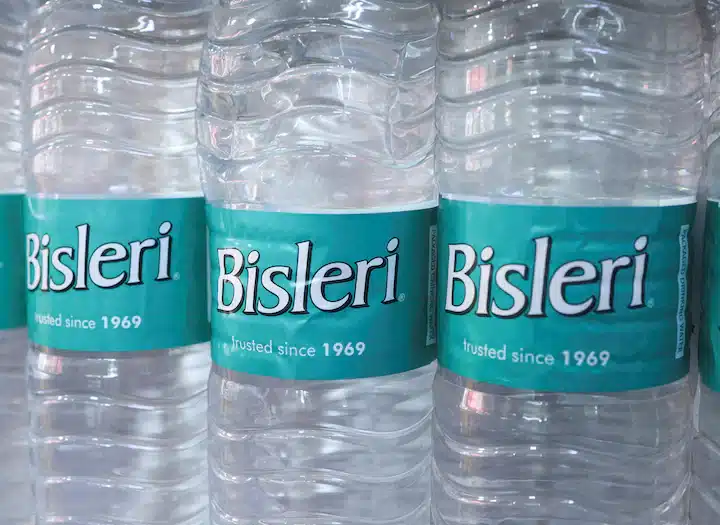
The Bisleri drinking water safety investigation has taken a major turn after India’s food safety regulator declared a sample from the country’s leading bottled water brand unsafe, prompting plans to expand testing to products from other manufacturers nationwide.
The Food Safety and Standards Authority of India (FSSAI) detected chemicals exceeding prescribed safety limits in a sample collected from Bisleri International’s premises. The findings have also triggered plans for legal proceedings against the company, according to government sources cited by Reuters.
The development represents a significant setback for Bisleri, one of India’s most recognisable packaged drinking water brands, whose products are widely consumed in homes, restaurants and commercial establishments.
The regulator’s initial laboratory findings identified bromate above the permitted limit. However, after Bisleri challenged the result, another laboratory examination detected a different group of chemicals known as polynuclear aromatic hydrocarbons (PAHs) in the same sample.
The investigation has raised questions about bottled water quality and regulatory enforcement in a country where concerns about unsafe public water supplies have made packaged drinking water an important household necessity.
FSSAI expands investigation after Bisleri water sample fails safety tests
India’s food safety regulator is preparing to widen its investigation beyond Bisleri as authorities seek to establish whether similar quality concerns exist across the packaged drinking water industry.
A government source told Reuters that the FSSAI intends to test additional Bisleri samples collected from different parts of India, alongside products manufactured by other bottled water companies.
The planned nationwide checks form part of a broader effort to strengthen food safety enforcement and ensure that products reaching consumers comply with established standards.
Bromate detected above permitted limit
The first laboratory examination found bromate in a Bisleri water sample at a level exceeding the regulatory threshold.
Bromate is a chemical that can occur as a by-product of certain water disinfection processes. Its presence in drinking water is regulated because excessive exposure can present health concerns.
The FSSAI disclosed the initial finding in a social media post on Sunday, stating that the sample collected from Bisleri’s premises did not meet the prescribed bromate limit.
The company subsequently challenged the laboratory result, leading to another examination of the sample.
However, the second assessment did not clear the product. Instead, the regulator reported detecting polynuclear aromatic hydrocarbons, commonly known as PAHs.
The two findings have intensified scrutiny of the sample and raised questions about the circumstances surrounding the contamination.
Second laboratory identifies PAHs
PAHs are a group of chemical compounds that have attracted public health attention because of their potentially harmful properties.
Research published last year and available through the US National Library of Medicine’s PubMed database identified concerns associated with their toxic, mutagenic and carcinogenic characteristics.
The detection of PAHs in the Bisleri sample has therefore added another dimension to the regulatory investigation.
However, the reported findings relate to the particular sample examined. They do not establish that every Bisleri bottle currently available in the market contains the chemicals or presents the same safety concern.
The FSSAI’s planned additional testing will be important in determining whether the problem was isolated or indicates a wider quality-control issue.
Bisleri challenges findings but pledges cooperation
Bisleri International has defended its quality-control arrangements following the regulator’s findings, insisting that drinking water safety remains a priority for the company.
In a statement to Reuters, the company said: “Drinking water safety is a priority for Bisleri. We maintain stringent quality controls.”
It also said it would cooperate with regulators as the investigation continues.
The company explained that the sample collected from its Goa facility last year contained bromate at 12 micrograms per litre, compared with the prescribed limit of 10 micrograms per litre.
Bisleri maintained that additional independent testing arranged by the company showed the chemical was within the required limits.
The disagreement between the company’s assessment and the regulator’s findings has become an important part of the investigation.
Company says scrutiny dates back to September 2025
Bisleri said the regulatory scrutiny began in September 2025, indicating that the matter has been under examination for more than a year.
A government source told Reuters that batches associated with the unsafe sample had been recalled and that subsequent testing of products showed no problems with water quality.
However, correspondence reviewed by Reuters presented an additional detail about the recall issue.
A letter Bisleri sent to the FSSAI in February indicated that no product from the affected batch remained in the market by that time, meaning the products had already been sold or consumed.
The distinction is important because it raises questions about the timing of the regulatory response and the availability of affected products when the recall issue was addressed.
Nevertheless, the government source maintained that subsequent testing had not identified further water-quality problems.
The regulator’s decision to conduct additional checks suggests that authorities want broader evidence before drawing conclusions about the company’s products and the wider industry.
Health concerns emerge over chemicals detected in sample
The chemicals identified in the Bisleri sample have different potential health implications, making compliance with drinking water standards particularly important.
PAHs are regarded as a public health concern because some compounds within the group possess toxic and potentially cancer-causing properties.
Bromate exposure can also be harmful at sufficiently high concentrations. According to information cited by Reuters from the New York health department, some individuals who consumed very high concentrations experienced kidney problems and hearing loss.
However, those cases involved exposure levels many thousands of times higher than the drinking water standard.
Why prescribed drinking water limits matter
Regulatory limits are established to help protect consumers from potentially harmful substances in products intended for regular consumption.
Bottled water companies are therefore expected to maintain effective treatment systems, monitor production processes and ensure that finished products comply with applicable standards.
The Bisleri investigation highlights why independent laboratory testing and regulatory oversight remain essential, particularly in markets where millions of consumers depend on packaged water.
It is equally important to distinguish between detecting a chemical in a particular sample and establishing that consumers have suffered harm.
The available findings do not demonstrate that the affected sample caused illness or that all products manufactured by Bisleri are unsafe.
Further testing will be necessary to establish the extent of the problem and determine whether additional regulatory action is justified.
Bisleri’s market position faces fresh scrutiny
The investigation is particularly significant because Bisleri occupies a prominent position in India’s packaged drinking water industry.
Its familiar 20-cent bottle has helped establish the brand as a household name in a country where unreliable access to clean drinking water has encouraged widespread consumption of bottled alternatives.
The company competes with major international beverage manufacturers, including PepsiCo and Coca-Cola, in India’s packaged water market.
Industry estimates cited by Reuters place Bisleri’s valuation above $3.5 billion, underlining its commercial importance.
Nationwide distribution network and Bollywood endorsements
Bisleri says it operates 130 production plants, works with 5,980 distributors and maintains a fleet of 8,270 transport trucks across India.
Its products also benefit from considerable brand recognition, supported by endorsements from Bollywood stars including Shahid Kapoor and Deepika Padukone.
The company’s scale means that regulatory action could attract significant attention from consumers, distributors, retailers and competitors.
Bisleri recorded annual sales of 32 billion Indian rupees, equivalent to approximately $345.31 million, in the financial year ending March 2025.
The company also expanded internationally, launching in the United Arab Emirates last year as it sought to benefit from demand among consumers familiar with the brand.
Bisleri described the region as offering significant growth opportunities, particularly because of its large Indian diaspora.
The current investigation therefore comes at a sensitive time for a company seeking to maintain its domestic leadership while expanding its international presence.
India intensifies food safety enforcement against major brands
The action against Bisleri forms part of a wider campaign by Indian food safety authorities to improve compliance across the country’s food and beverage industries.
The FSSAI and state regulators have conducted raids, ordered shutdowns and challenged companies over issues including improper product labelling.
Reuters previously reported on enforcement actions affecting businesses in different sectors, including restaurant operators such as Domino’s and liquor companies including Diageo.
The latest investigation signals that packaged drinking water manufacturers are also facing closer scrutiny.
Wider checks could affect the bottled water industry
The planned expansion of laboratory testing to other bottled water brands could have implications for the entire industry.
Manufacturers may face increased pressure to demonstrate that their treatment processes, production facilities and distribution arrangements meet regulatory requirements.
For consumers, the investigation could also renew attention on the quality of bottled water and the importance of checking product standards.
Read also: Eisenkot condemns West Bank settler attacks as ‘Jewish terrorism’ amid Israeli political crisis
https://swiftreportnow.com/eisenkot-condemns-west-bank-settler-attacks/
The regulator’s findings against Bisleri do not automatically establish that competing brands have similar problems. However, testing products across the industry could help identify potential weaknesses before they become wider public health concerns.
For Bisleri, the immediate challenge will be to cooperate with authorities, address the regulator’s concerns and maintain consumer confidence while the investigation continues.
The Bisleri drinking water safety investigation has consequently become an important test of India’s food safety enforcement efforts. With legal proceedings being considered and nationwide checks planned, the outcome could influence regulatory oversight of the country’s entire packaged drinking water market.
About The Author