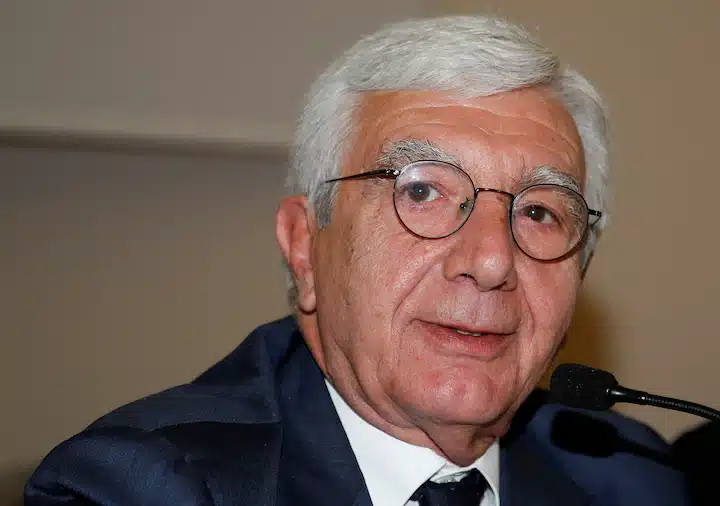
Former Italian police chief Gianni De Gennaro has died by suicide at the age of 78 while under investigation over alleged attempts to obstruct a renewed inquiry into the 1992 mafia bombing that killed anti-mafia magistrate Paolo Borsellino and five police officers.
De Gennaro, one of Italy’s most influential security officials, was found dead at his country residence in Tuscany on Saturday, November 21, according to an official familiar with the matter cited by Reuters.
His death came days after prosecutors in Sicily sought to place him under house arrest over allegations linked to efforts to interfere with investigations into the assassination of Borsellino, one of Italy’s most prominent anti-mafia judges.
Although a judge rejected the prosecutors’ request, they appealed the decision, with a ruling expected in the coming weeks. De Gennaro had denied wrongdoing and was reportedly deeply affected by the investigation.
De Gennaro’s death follows renewed mafia investigation
The investigation surrounding De Gennaro centres on allegations of attempts to obstruct inquiries into the 1992 car bombing in Palermo that killed Borsellino and five police escorts.
Prosecutors in Caltanissetta, Sicily, had recently sought to impose house arrest on the former police chief as part of the investigation, although the request was rejected by a judge.
The prosecution subsequently appealed, leaving the legal proceedings unresolved at the time of his death.
De Gennaro’s lawyer, Francesco Bertorotta, told La Repubblica that his client had been deeply shaken by the allegations and the circumstances surrounding the renewed investigation.
“He was deeply shaken,” Bertorotta said, recalling his conversation with De Gennaro during the week.
The lawyer added that the former police chief sounded distraught about having to defend himself against accusations he regarded as unjust and defamatory.
Investigation opened following his death
De Gennaro was reportedly discovered at his country home in Tuscany after relatives became concerned when they could not reach him.
Following his death, prosecutors in Grosseto, the province where the property is located, opened an investigation into suspected incitement to suicide, according to the Italian news agency Ansa.
Investigators reportedly discovered notes addressed to family members believed to be farewell messages, alongside other documents.
The circumstances surrounding his death are being examined, while the investigation into the allegations connected to the Borsellino assassination remains one of Italy’s most sensitive criminal inquiries.
Borsellino assassination remains one of Italy’s darkest chapters
The 1992 killing of Paolo Borsellino remains one of the most controversial and painful episodes in Italy’s fight against organised crime.
Borsellino was murdered in a car bombing in Palermo less than two months after another prominent anti-mafia magistrate, Giovanni Falcone, was killed in a separate bombing.
Both judges were leading figures in the battle against Sicily’s powerful Cosa Nostra mafia organisation, whose criminal activities had threatened Italy’s institutions and public security for decades.
De Gennaro had worked closely with Falcone during landmark investigations into organised crime, making his later involvement in an investigation connected to the Borsellino assassination particularly significant.
The original investigations into Borsellino’s murder resulted in the identification and prosecution of suspects, some of whom were subsequently found innocent.
Later inquiries examined allegations that investigators had obtained false confessions and that misleading information had influenced the investigation, raising serious questions about how the assassination was handled.
The circumstances surrounding those developments have remained disputed, while investigators have continued efforts to establish the full truth about the bombing and identify those responsible for misleading the inquiry.
Borsellino family reacts to former police chief’s death
The Borsellino family has repeatedly called for clarity and accountability over the circumstances surrounding the magistrate’s assassination.
Reacting to De Gennaro’s death, Manfredi Borsellino, the slain magistrate’s son, expressed concern that the development could complicate efforts to uncover the truth.
“Another piece of the truth may have gone (with him),” he said.
The statement reflected the family’s longstanding frustration over the unanswered questions surrounding the killing and the possibility that important information could remain unresolved.
De Gennaro’s death has also triggered reactions across Italy’s political establishment, with Prime Minister Giorgia Meloni expressing condolences to his family.
Some political allies criticised the intensity of media coverage surrounding the investigation, arguing that the allegations against him had not been established in court.
Deputy Prime Minister Antonio Tajani stressed that criminal allegations should be handled through judicial proceedings rather than public condemnation.
“In a free, democratic and civilised country, justice is administered in courtrooms, not outside them,” Tajani said.
De Gennaro built career fighting organised crime
De Gennaro had a long career in Italy’s law enforcement and intelligence institutions, rising to become one of the country’s most prominent security figures.
Nicknamed “The Shark”, he played a significant role in investigations targeting the Sicilian mafia during the 1980s and 1990s and worked alongside Falcone on major anti-mafia operations.
He also helped oversee the extradition from Brazil of Tommaso Buscetta, a prominent mafia informant whose revelations became important in exposing the structure and operations of Cosa Nostra.
De Gennaro later headed Italy’s Anti-Mafia Investigative Directorate before becoming national police chief, a position he held from 2000 to 2007.
Following his police leadership role, he headed Italy’s intelligence coordination department, placing him among the country’s most influential security officials.
Controversies during his public service
Despite his prominent career, De Gennaro’s public service was not without controversy.
As national police chief, he oversaw security operations during the 2001 Group of Eight summit in Genoa, which was marked by violent clashes between police officers and anti-globalisation demonstrators.
The summit became one of the most controversial episodes in modern Italian policing, attracting criticism over police conduct and the handling of protests.
De Gennaro denied wrongdoing and was ultimately acquitted in a related case.
In 2013, he was appointed chairman of Finmeccanica, the state-controlled aerospace and defence company later renamed Leonardo.
Read also: Mark Carney popularity raises questions over how long Canadians will tolerate his controversial policies
https://swiftreportnow.com/mark-carney-popularity-raises-questions-over/
He remained in the position until 2020, concluding a career that spanned law enforcement, intelligence, national security and corporate leadership.
His death has now added another complicated dimension to the unresolved questions surrounding the Borsellino assassination, a case that continues to hold enormous significance in Italy’s history and its fight against organised crime.
About The Author