The Netanyahu political showdown intensified on Tuesday as Israel’s newly sworn-in parliament became the scene of an opposition offensive aimed at weakening Benjamin Netanyahu‘s influence and potentially preventing his return to power.
Although the six opposition parties have not yet overcome their differences to form a government, they are already using their parliamentary majority to challenge Netanyahu’s allies and take control of important legislative positions.
Their first target is the Knesset speakership, currently held by Amir Ohana, a Netanyahu loyalist. The opposition has requested a vote to replace him, which would give the six parties greater control over the legislature’s agenda.
The move is significant because it would allow opposition lawmakers to pursue important legislation even if negotiations to establish a governing coalition prove unsuccessful.
Among their priorities are a state commission of inquiry into the 7 October 2023 attacks and legislation introducing term limits for Israeli prime ministers. The latter could prevent Netanyahu from returning to office.
Netanyahu has led Israel for 19 of the past 30 years, making the proposed restrictions a potentially major obstacle to his political ambitions.
Eisenkot receives mandate to form a government
Former Israeli military chief Gadi Eisenkot has been given the presidential mandate to attempt to form a new government, placing him at the centre of the opposition’s effort to remove Netanyahu.
He has six weeks to negotiate an agreement among parties whose election promises and political positions are difficult to reconcile.
Eisenkot has acknowledged that the negotiations will be exceptionally complicated, describing the path to power as “extraordinarily complex”.
However, he has argued that removing Netanyahu represents a national emergency, suggesting that the opposition parties may need to abandon or reconsider some campaign commitments to reach an agreement.
If Eisenkot fails, another candidate, most likely Netanyahu, will receive an opportunity to form a government. A second failure could lead to another election.
Until the political deadlock is resolved, Netanyahu is likely to remain caretaker prime minister, extending his time in office despite the loss of his coalition’s parliamentary majority.
Netanyahu attacks Palestinian-led opposition parties
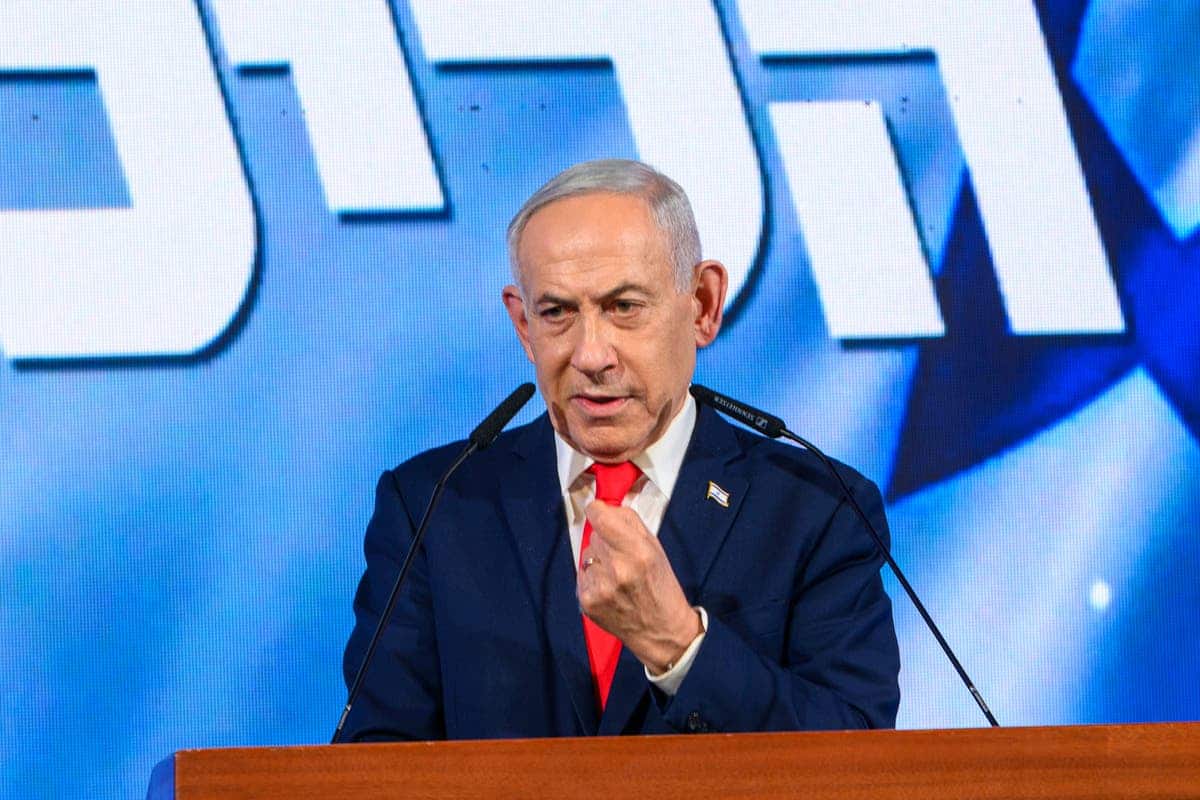
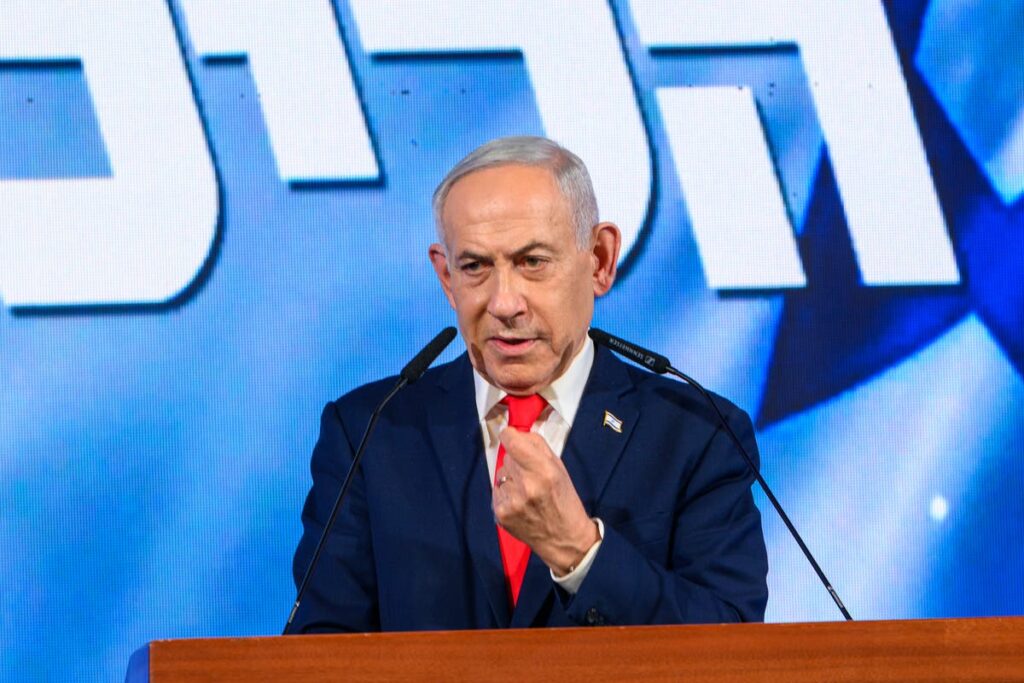
The tensions became particularly visible during Netanyahu’s address at Tuesday’s Knesset inauguration.
The prime minister launched an attack on two Palestinian-led opposition parties whose lawmakers were essential to removing his coalition from power, describing their representatives as “terror supporters”.
Eisenkot strongly condemned the remarks, calling the speech a “delusional, divisive, hate-filled and shameful” exploitation of a state occasion.
He said Netanyahu’s conduct demonstrated that the prime minister was unfit for office.
The speech also prompted Yair Golan, leader of the centre-left Democrats, and Yoav Segalovich, a Jewish-Israeli former police chief who contested the election on the Islamist Ra’am party’s slate, to walk out in protest.
Palestinian citizens account for approximately 20% of Israel’s population, and their political parties have become important players in the country’s parliamentary calculations.
Netanyahu had made attacks on these voters and their parties a central part of his election campaign. Since polling day, he has also promoted allegations of electoral fraud in Palestinian communities in an apparent effort to undermine the results.
However, election officials have said there was no evidence of irregularities that affected the outcome or compromised the election’s integrity.
Opposition prepares to reverse judicial reforms
Eisenkot’s Yashar party moved quickly after the inauguration, submitting several bills to parliament with the support of other opposition groups.
Apart from the proposed term limits and an independent investigation into the 7 October attacks, the legislation seeks to reverse aspects of Netanyahu’s controversial judicial overhaul.
The overhaul weakened the powers of Israel’s judiciary and the attorney general, becoming one of the most divisive issues during Netanyahu’s previous government.
The opposition wants to undo those changes, alongside pursuing an official investigation into the attacks that triggered the current political and security crisis.
Its lawmakers have also nominated candidates to take over important defence and finance committees, giving the opposition an opportunity to influence parliamentary scrutiny of national security and government spending.
The effort to replace Ohana is another central part of the strategy. As speaker, he controls the Knesset’s agenda, making the position particularly important in determining which legislative proposals receive attention.
Ohana has scheduled the vote to choose his successor for next Tuesday, the latest possible date.
Herzog appeals for political compromise
President Isaac Herzog used the swearing-in ceremony to urge lawmakers to avoid another election and find common ground despite their political disagreements.
His appeal came as the opposition struggled to reconcile the competing demands of parties that had campaigned against Netanyahu but were not necessarily united on other policy issues.
“Reach out a hand for compromise, even between rivals … Look upon one another with generosity. There is much work to be done here, and it requires the ability and experience found in every part of this House,” Herzog said.
The president’s warning reflects concerns that prolonged coalition negotiations could leave Israel trapped in another period of political uncertainty.
A new election would also extend Netanyahu’s caretaker leadership while giving the divided opposition another opportunity to test its electoral strength.
Netanyahu’s hold on Israeli politics faces a new test
The opposition’s immediate objective is to use its parliamentary majority to secure control of the speakership, influential committees and the legislative agenda.
Read:Russian foreign recruitment: Indonesian man captured fighting for Moscow as trafficking fears grow
https://swiftreportnow.com/russian-foreign-recruitment-indonesian-man/
Even without forming a government, the six parties believe they can weaken Netanyahu’s influence by advancing legislation on judicial reform, prime ministerial term limits and the investigation into the 7 October attacks.
However, their ability to sustain cooperation remains uncertain because of conflicting election promises and differences among their political platforms.
Eisenkot’s six-week mandate will determine whether the opposition can turn its parliamentary advantage into a governing coalition.
If he succeeds, Netanyahu could lose power. If he fails, the prime minister may receive another opportunity to form a government, potentially bringing Israel closer to another election.
The struggle is therefore not simply about replacing one prime minister with another. It also concerns the future direction of Israel’s political institutions and the extent to which Netanyahu’s policies can be reversed.
About The Author