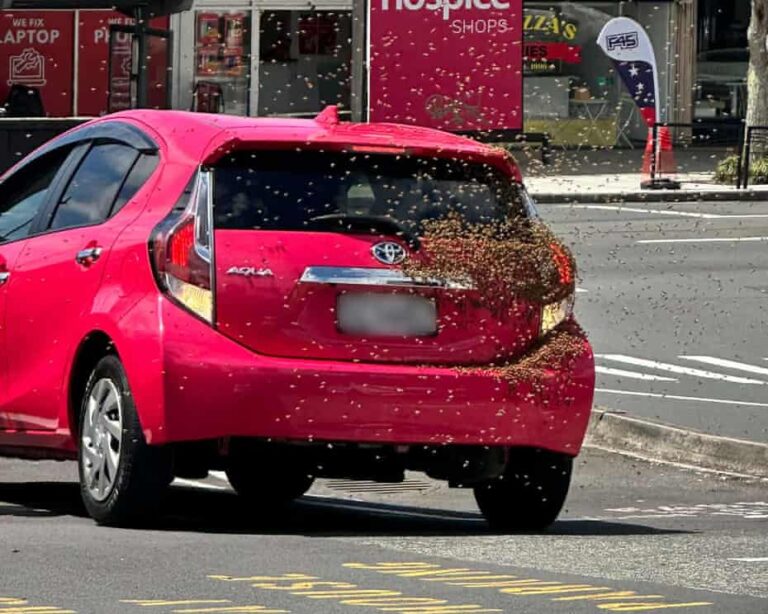
Auckland bee swarms are increasing dramatically across New Zealand‘s largest city, with beekeepers reporting an unprecedented rise in requests for assistance after an unusually mild winter and warmer start to spring encouraged colonies to multiply and split earlier than normal.
Residents in Auckland have encountered large groups of bees covering parked vehicles, surrounding street signs and occupying busy public spaces, prompting growing concern among people unfamiliar with the insects’ natural behaviour.
The Auckland Beekeepers Association says it is receiving between five and 10 daily requests from residents seeking help to remove swarms, a significant increase compared with previous years.
Bryan Lang, the association’s swarm control coordinator, said the organisation previously received fewer than five calls daily but had already handled at least 100 call-outs during the current season.
The unusually high demand has also placed individual members under pressure, with residents contacting beekeepers directly when large colonies settle around their homes or neighbourhoods.
Bees take over parked cars and busy Auckland streets
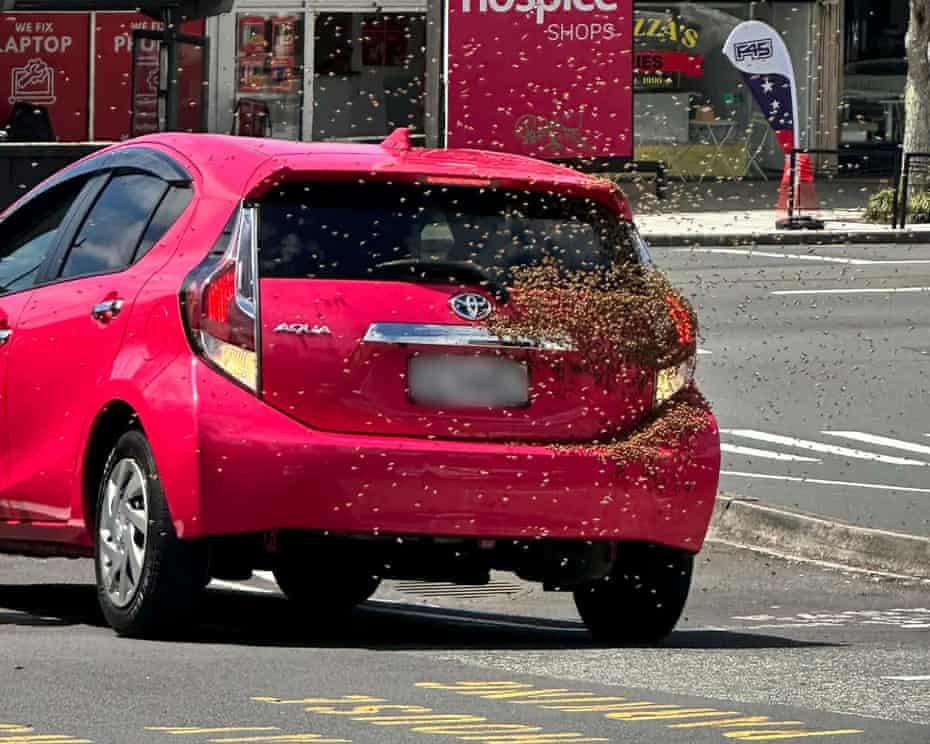
One particularly unusual incident occurred in October when a massive swarm covered the back of a parked car in Birkenhead, remaining there for approximately two hours.
According to witnesses, a woman was sleeping inside the vehicle when the bees gathered around it. Lang said he understood that she had been unaware of the insects outside.
“I’m surprised she didn’t hear them because they’re pretty loud,” he said.
Another incident happened a month earlier when bees occupied a street sign at a busy intersection along Queen Street, one of Auckland’s major commercial thoroughfares.
The swarm forced pedestrians to change their routes as people attempted to avoid the large concentration of insects.
Photographs from the incidents showed thousands of bees clustering around everyday urban objects, illustrating how the unusually active season has brought the insects into closer contact with city residents.
The growing number of incidents has also increased public interest in understanding why bees swarm and how people should respond when colonies settle in residential or commercial areas.
Why thousands of bees leave their hives
Swarming is a natural part of the honeybee life cycle, particularly during spring and early summer.
It happens when a colony becomes sufficiently large that part of the population leaves its existing hive in search of another suitable home or additional resources.
The departing bees temporarily gather in a particular location while scout bees search for an appropriate place where the new colony can establish itself.
Although the sight of thousands of insects flying together can be intimidating, experts say swarming bees are generally less aggressive than people might expect.
Ken Brown, president of the Auckland Beekeepers Association, said people living in rural communities were often more familiar with the phenomenon than city residents.
“When bees swarm in the countryside, no one really notices,” he said.
He explained that urban residents unfamiliar with bee behaviour could become frightened by the sight of thousands of insects gathering around buildings, vehicles and public spaces.
“If you don’t know about bees – how they’re only defensive – then you might be intimidated with thousands of venomous insects flying around,” Brown said.
He added that a colony is generally at its most placid while swarming.
Nevertheless, Lang warned that swarming is not necessarily welcome news for commercial beekeepers because they can lose a substantial proportion of their colonies’ population.
“As a beekeeper, you don’t want them to swarm because you’re losing two-thirds of your bees, and right at the time when they should be bringing honey in for you,” Lang said.
“And it’s not great for your neighbours either.”
Milder winter blamed for earlier and larger swarms
Beekeepers believe unusual weather conditions have contributed significantly to the current increase in Auckland.
Brown said the relatively warm winter and beginning of spring had encouraged colonies to develop earlier, resulting in more bees leaving their original hives weeks ahead of the usual pattern.
New Zealand experienced its third-warmest winter on record in 2026, according to Earth Sciences New Zealand.
The warmer conditions may have allowed colonies to maintain stronger populations and develop more rapidly than they normally would during colder months.
Brown explained that milder winter temperatures could encourage a colony to produce a larger brood, consisting of eggs, larvae and pupae.
If the colony avoids serious damage from parasites such as the varroa mite, the surviving population can become stronger and more likely to swarm earlier.
The varroa mite is a destructive parasite that attaches to honeybees and their developing brood, threatening the health and survival of colonies.
Brown said changing weather patterns were making beekeeping increasingly unpredictable.
“Beekeeping is much more unpredictable nowadays because you do have the extremes of weather and the different patterns. Every year is slightly different, but it’s actually even more different in recent times,” he said.
Similar changes in bee behaviour have also been reported in North America, where warmer winters and earlier spring conditions have contributed to shifts in seasonal swarming patterns.
Climate change adds uncertainty to bee populations
The Auckland situation reflects wider concerns about how changing temperatures are influencing wildlife and the seasonal behaviour of insects.
Warmer winters can alter the development of bee colonies, potentially changing when populations become strong enough to reproduce through swarming.
However, the consequences are not necessarily negative in every situation.
Professor Phil Lester, an entomologist and ecologist at Victoria University, said beekeepers had also been actively capturing swarms in other parts of New Zealand, including Wellington.
He noted that swarms that are not captured can create problems for other honeybee colonies and native bees, particularly when they carry varroa mites.
The parasite can spread through contact between colonies, making unmanaged swarms a potential concern for the wider bee population.
For commercial beekeepers, losing large numbers of bees during the period when colonies should be preparing to produce honey can also affect productivity.
Despite these concerns, Lester said the increased swarming activity could indicate that bee populations were developing strongly this year.
“It means they have been able to build up numbers and populations, earlier than perhaps they normally would do … its probably a good indication that it is a good bee year.”
Residents increasingly turn to beekeepers for assistance
As swarms become more visible across Auckland, residents are increasingly seeking professional assistance rather than attempting to handle the insects themselves.
The Auckland Beekeepers Association says public awareness is improving, with more people using social media groups dedicated to bee swarming and contacting local beekeeping clubs.
The growing number of requests suggests that residents are becoming more conscious of the need to manage swarms safely, particularly when colonies settle in busy public areas.
For beekeepers, however, the unusually active season has created additional work at a time when they would normally be concentrating on maintaining colonies and preparing for honey production.
Read also: Russia-Ukraine peace talks open in Abu Dhabi as Trump pushes new European security deal
https://swiftreportnow.com/russia-ukraine-peace-talks-open-in-abu-dhabi/
The current increase also presents a complicated picture for New Zealand’s bee population.
While stronger colonies and earlier population growth could indicate favourable conditions for bees, the spread of parasites and increasingly unpredictable weather patterns remain significant challenges.
For Auckland residents, the immediate reality is that encounters with large swarms may become more frequent during the warmer months.
Experts say understanding the natural behaviour of bees is important in reducing unnecessary panic, while allowing experienced beekeepers to manage colonies that settle in unsuitable locations.
About The Author