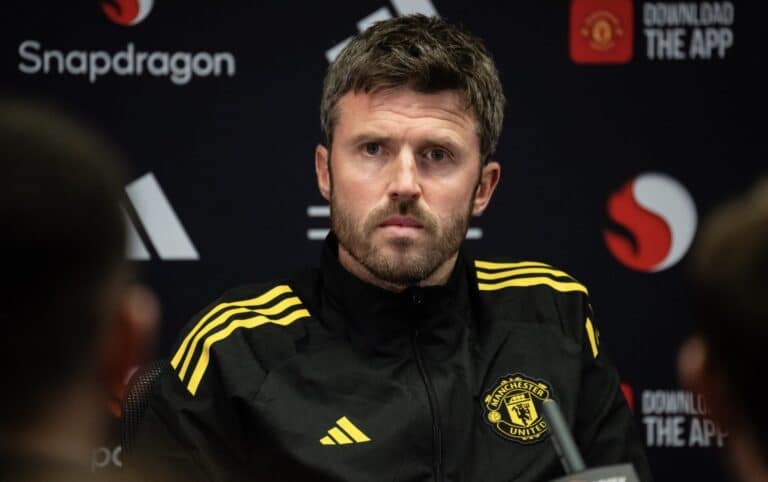
The Benjamin Sesko injury has dealt Manchester United another major setback, with the Slovenian striker reportedly expected to remain sidelined until at least January, leaving manager Michael Carrick short of recognised centre-forward options during a difficult period for the club.
The 23-year-old has not featured since Manchester United’s Carabao Cup defeat to Brighton on September 16. He was substituted in the 66th minute, and subsequent medical investigations have kept him out of action.
According to BBC Sport, the club has conducted several tests to determine the cause of the problem. Carrick has reportedly been seeking updates on the striker’s recovery, but the latest indications suggest that a return before January is unlikely.
Sources cited in the report have indicated that the current issue is an impact injury rather than shin splints. Although the problem affects the same area, it is understood to be different from his initial complaint.

Recurring shin trouble disrupts Sesko’s season
The injury is particularly concerning because Sesko has experienced similar difficulties before. His shin problem reportedly prevented him from taking part in pre-season preparations and also troubled him during the previous campaign.
The condition flared up during a match against Liverpool in May, forcing him to miss Manchester United’s final three Premier League fixtures last season.
The latest setback has again interrupted his progress, raising concerns about his ability to maintain consistent fitness. For a young striker adapting to the demands of English football, repeated spells on the sidelines can disrupt momentum and limit opportunities to build partnerships with teammates.
United will need to manage his rehabilitation carefully rather than prioritising an immediate return at the expense of his longer-term fitness.
United’s attacking options come under pressure
Sesko’s expected absence exposes a major weakness in Manchester United’s current attacking arrangements: the lack of another recognised central striker.
His presence gives the team a natural focal point in the final third, allowing teammates to play passes into the penalty area and providing an option against defenders who prefer to operate higher up the pitch.
Without him, Carrick must find alternative ways to lead the attack. Available players may be required to operate in unfamiliar positions, while the manager could also consider changing the team’s formation or approach to creating goalscoring opportunities.
Such adjustments are possible, but they could prove difficult during a period when United are already struggling for results.
Sesko’s contribution since arriving from RB Leipzig in August 2025 explains why his absence matters. The transfer reportedly cost £73.7 million, and the striker has recorded 14 goals and one assist in 38 appearances across all competitions.
His record also highlights his importance in the Premier League. Despite missing eight matches last season, he scored 11 league goals, finishing level with Bryan Mbeumo as United’s joint-leading scorer in the competition.
Those numbers underline the challenge facing Carrick as he attempts to replace Sesko’s goals and overall presence in attack.
Promising start interrupted by another setback
Sesko had already found the net twice this season before his injury halted his progress.
The Slovenian scored against Everton in the Premier League and Sabah FK in the Champions League. Following the European fixture, he spoke about his relief at being free from injury, raising hopes that he could enjoy a more settled period.
Unfortunately, the latest problem has again interrupted his campaign.
His prolonged absence means United must prepare for a substantial stretch without a striker who was expected to play an important role in their attacking plans.
The situation also creates uncertainty over when he can regain match fitness. Even after receiving medical clearance, Sesko may require time to rebuild his sharpness before returning to the demands of competitive football.
For United, the immediate priority will be finding enough goals from other areas of the team while ensuring the striker is not rushed back prematurely.
Liverpool and Arsenal clashes add to the challenge
The reported recovery timeline means Sesko is expected to miss several important matches, including Premier League meetings with Liverpool and Arsenal.
He is also expected to be unavailable for at least three Champions League fixtures, leaving Carrick with fewer opportunities to rotate his attacking players during a demanding schedule.
Matches against leading opponents often require a reliable goalscoring threat, particularly when teams are under pressure to collect points. United’s ability to compete in these encounters could depend partly on whether their remaining forwards can take advantage of the opportunities created.
The injury also places greater responsibility on the midfield to contribute goals and provide better service to the attack. United may need to become more effective from set pieces, counterattacks and wide positions to compensate for the missing striker.
However, the extent to which these adjustments can improve results remains uncertain, especially given the team’s recent difficulties.
January transfer window could offer a solution
Sesko’s absence could influence Manchester United’s transfer strategy when the January window opens.
The shortage of a specialist centre-forward has reportedly been cited as one reason for the club’s poor form. With their principal recognised number nine unavailable for an extended period, the argument for adding another striker may become stronger.
Recruiting a forward could provide immediate cover and reduce the risk of relying too heavily on a limited number of attacking players. It would also give Carrick more flexibility when selecting his team.
Nevertheless, signing a replacement is not guaranteed. United may decide to assess Sesko’s progress before committing to another expensive acquisition, while the availability and cost of suitable targets could also affect their decision.
The club must weigh the benefits of strengthening the squad against the longer-term implications of adding another striker to a group that already includes Sesko when fit.
For now, the injury has created an additional problem for a team that needs both better results and greater stability.
Carrick faces mounting pressure before Chelsea fixture
The striker’s setback comes amid a difficult run for United. At the time of the report, the club sat 16th in the Premier League table, with their only league victory coming against Ipswich on August 30.
United had also gone without a win in all competitions since September 10, intensifying scrutiny of Carrick’s management.
A 4-1 Champions League defeat to Como last Wednesday added to the pressure. Captain Bruno Fernandes reportedly criticised the manager’s tactics after that match, while the midfielder was subsequently left unused during Sunday’s 3-0 home loss to Bournemouth.
Reports also indicated that Fernandes and Carrick held talks on Tuesday in an effort to resolve tensions.
Carrick had been widely expected to be dismissed following the Bournemouth defeat, but he was still expected to take charge against Chelsea on Saturday.
The manager must now prepare for that fixture and the matches that follow without Sesko, while also attempting to restore confidence within the squad.
The outcome of United’s next few games could be important for Carrick’s future, particularly if the team continues to struggle for goals and points.
The Benjamin Sesko injury therefore presents Manchester United with problems beyond the striker’s personal recovery. His absence weakens the club’s attacking options, increases pressure on Carrick and could influence recruitment decisions ahead of the January transfer window.
About The Author